Reasonable Rates

Advanced ACT Math Problems Book: ratio of areas inscribed shapes

This page covers ratio of areas inscribed shapes, a challenging and advanced topic from the book "Advanced ACT Math". The problems here focus on 2D and 3D figures where shapes are inscribed in circles, spheres, and other geometric forms. Understanding these concepts is crucial for students aiming for top scores, as they appear frequently on the test and are often not covered in detail in other materials.

The exercises include squares and rectangles inscribed in circles, right triangles with hypotenuses as diameters, and cubes inside spheres, along with methods for calculating areas, Ratio of Areas in Inscribed Shapes, and volumes. These problems are designed to push students beyond standard practice and develop strong problem-solving skills.

All of this material is taken directly from my ACT Math Problems Book, providing a reliable and structured source for advanced preparation. You can learn more about the book on my site ACT math book or on Amazon here.

These are challenging problems that appear frequently on the test but are not covered in detail in other materials. The key principle is that the diagonal of a rectangle or the hypotenuse of a right triangle is the diameter of the circumscribed circle. Similarly, for three-dimensional figures, the long diagonal of an inscribed cube is the diameter of the circumscribed sphere.

2D

If a rectangle is inscribed in a circle, the diameter of the circle equals the diagonal of the rectangle (note that a square is a special case of a rectangle). Similarly, if a right triangle is inscribed in a circle, the diameter of the circle equals the hypotenuse of the triangle.

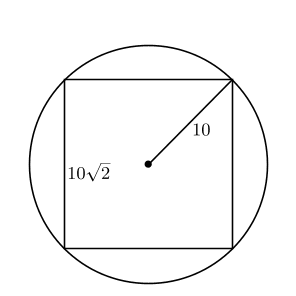
For example, consider a square inscribed in a circle with an area of $100\pi$ square units. To find the area of the square, first determine the radius of the circle: $$ \pi r^2 = 100\pi \implies r^2 = 100 \implies r = 10. $$ Since the diagonal of the square corresponds to the diameter of the circle, the diagonal length is $2r = 20$. Using the properties of a $45^\circ$-$45^\circ$-$90^\circ$ triangle, the Pythagorean Theorem, or trigonometry, the side length $s$ is $\dfrac{20}{\sqrt{2}}= 10\sqrt{2}$. Thus, the area of the square is $(10\sqrt{2})^2=200$.
A frequent variation involves a circle inscribed in a square. This concept may also be framed in terms of multiple circles or cylindrical cans arranged within a box.

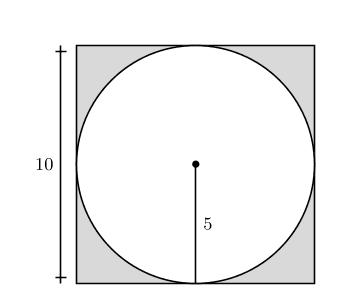
For instance, consider a circle with radius $r=5$ inscribed in a square. To find the area of the region inside the square but outside the circle, first note that the diameter of the circle is $2(5)=10$. This diameter equals the side length of the square. The area of the square is $10^2=100$, and the area of the circle is $\pi(5^2)=25\pi$. Therefore, the area of the region between the circle and the square is $100-25\pi$.
1. If a circle is inscribed in a square, what is the ratio of the area of the circle to the area of the square? 4
  1. $ \dfrac{\pi}{5} $
  2. $ \dfrac{\pi}{4} $
  3. $ \dfrac{\pi}{3} $
  4. $ \dfrac{2}{\pi} $

Show correct answer

B

2. If a square is inscribed in a circle, what is the ratio of the area of the square to the area of the circle? 4
  1. $ 9:4\pi $
  2. $ 4:\pi^2$
  3. $ 2:\pi$
  4. $10:3\pi$

Show correct answer

C

3. If a square is inscribed in a circle, what is the ratio of the perimeter of the square to the circumference of the circle? 4
  1. $ 2\sqrt{2}:\pi $
  2. $2:\pi$
  3. $ 3:\pi$
  4. $5:2\pi $

Show correct answer

A

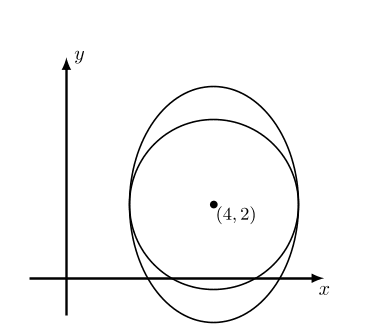
4. What is the largest circle that can be inscribed in the ellipse $ {\dfrac{(x-4)^2}{9}+\dfrac{(y-2)^2}{25}=1}$? 4
  1. $(x-4)^2+(y-2)^2=9$
  2. $(x-4)^2+(y-2)^2=1 $
  3. $ (x-4)^2+(y-2)^2=25 $
  4. $(x-4)^2+y^2=9$

Show correct answer

A

5. What is the area in square units of the square inscribed in $(x-4)^2+(y-2)^2=36$? 4
  1. $72$
  2. $75$
  3. $ 80 $
  4. $ 96 $

Show correct answer

A

6. A rectangle with side lengths 6 and 10 is inscribed in a circle. What is the area of the region lying inside the circle but outside the rectangle? 4
  1. $ 28\pi-60$
  2. $30\pi-60 $
  3. $ 32\pi-60 $
  4. $34\pi-60 $

Show correct answer

D

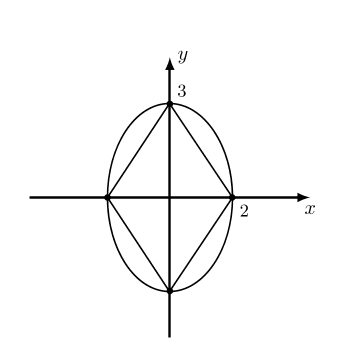
7. What is the area of the largest rhombus which can be inscribed in $\dfrac{x^2}{4}+\dfrac{y^2}{9}=1$? 4
  1. $ 10 $
  2. $ 11$
  3. $ 12$
  4. $ 8\sqrt{3}$

Show correct answer

C

8. If a right triangle with legs of length 2 and 3 is inscribed in a circle, what is the area of the circle? 5
  1. $3\pi$
  2. $\dfrac{15\pi}{4} $
  3. $ \dfrac{11\pi}{4} $
  4. $ \dfrac{13\pi}{4} $

Show correct answer

D

3D

Suppose a cube is inscribed in a sphere. The long diagonal of the cube is equal to the diameter of the sphere ($d=2r$). Since the long diagonal of a cube with side length $s$ is $s\sqrt{3}$ (a relationship derived using the Pythagorean Theorem twice), the side length is equal to the diameter divided by $\sqrt{3}$. Thus, $s = \dfrac{2r}{\sqrt{3}}$.
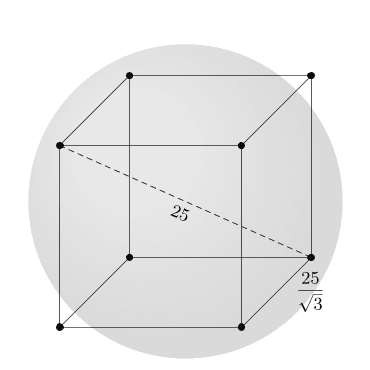
9. If a cube with side length 2 is inscribed in a sphere, what is the surface area of the sphere (surface area of a sphere is $4\pi r^2$)? 4
  1. $ 8\pi $
  2. $ 10\pi $
  3. $ 12\pi $
  4. $ \dfrac{32\pi}{3}$

Show correct answer

C

10. If a cube is inscribed in a sphere, what is the ratio of the volume of the sphere to the volume of the cube? 5
  1. $\pi:2 $
  2. $ \sqrt{3}\pi:2 $
  3. $2\pi:3 $
  4. $ \sqrt{3}\pi:3 $

Show correct answer

B

Answer key: 1.B, 2.C, 3.A, 4.A, 5.A, 6.D, 7.C, 8.D, 9.C, 10.B

Solutions

1. (B) Let the radius of the circle be $r=1$. The area of the circle is $\pi(1)^2 =\pi$. Since the diameter is 2, the side length of the square is 2. Calculate the area of the square: $2^2=4$. Thus, the ratio is $\dfrac{\pi}{4}$. Instead of $1$, it is possible to use some other number or $x$, but $1$ is simplest.
2. (C) Let the radius of the circle be $r=1$ (you could use a different number or variable, but 1 makes the calculations simplest). Then the diameter is 2, which corresponds to the diagonal of the square. The side length of the square is $\sqrt{2}$, derived using the Pythagorean Theorem or $45^\circ$-$45^\circ$-$90^\circ$ triangle ratios. Thus, the area of the square is $(\sqrt{2})^2=2$. The area of the circle is $\pi(1)^2=\pi$. The ratio is $2:\pi$.
3. (A) Let the radius of the circle be $r=1$ (again, you could assume other values, but 1 is easiest). Then the diagonal of the square is the diameter of the circle, which is 2. Therefore, the side length of the square is $\sqrt{2}$. The perimeter of the square is $4\sqrt{2}$, and the circumference of the circle is $2\pi$. Hence, the ratio is $4 \sqrt{2}: 2\pi=2\sqrt{2}:\pi$.
4. The circle must share the center $(4,2)$ with the ellipse. Its radius is determined by the ellipse's semi-minor axis, which is $\sqrt{9}=3$. Substituting these values into the standard circle equation $(x-h)^2+(y-k)^2=r^2$ yields $(x-4)^2+ (y-2)^2=9$.
5. (A) The radius is 6, so the diameter is 12. Using the rhombus area formula ($A = \dfrac{d_1 d_2}{2}$), the area of the square is $\dfrac{12^2}{2}=72$. Alternatively, determine that the side length is $\dfrac{12}{\sqrt{2}}=6\sqrt{2}$ using $45^\circ$-$45^\circ$-$90^\circ$ triangle ratios, the Pythagorean Theorem, or trigonometry. Thus, the area is $(6\sqrt{2})^2=72$.
6. (D) Calculate the diagonal of the rectangle: $\sqrt{6^2+ 10^2}=\sqrt{136}=2 \sqrt{34}$. The radius of the circle is half the diagonal ($r=\sqrt{34}$), so the area of the circle is $\pi(\sqrt{34})^2= 34\pi$. The area of the rectangle is $6(10)=60$. Thus, the area of the region inside the circle but outside the rectangle is $34\pi-60$.
7. (C) The major axis length is $2\sqrt{9}=6$, and the minor axis length is $2\sqrt{4}=4$. The diagonals of the rhombus correspond to these axes. Using the rhombus area formula ($A=\dfrac{d_1d_2}{2}$), the area is $\dfrac{4(6)}{2}=12$. Alternatively, calculate the area as the sum of 4 right triangles with legs 2 and 3: $4 \left( \dfrac{2(3)}{2} \right) = 12$.
8. (D) The hypotenuse length is $\sqrt{2^2+3^2}=\sqrt{13}$. Since the right triangle is inscribed, the hypotenuse corresponds to the diameter; therefore, the radius is $r=\dfrac{\sqrt{13}}{2}$. The area of the circle is $\pi r^2=\pi \left(\dfrac{\sqrt{13}}{2}\right)^2 =\dfrac{13\pi}{4}$.
9. (C) The long diagonal of the cube corresponds to the diameter of the sphere. For a cube with side length $s=2$, the long diagonal is $s\sqrt{3} = 2\sqrt{3}$ (derived using the Pythagorean Theorem in 3D). Thus, the radius is $r=\sqrt{3}$. The surface area of the sphere is $4\pi r^2 = 4\pi(\sqrt{3})^2 = 12\pi$.
10. (B) Let the side length of the cube be $s=2$. The volume of the cube is $s^3=8$. The long diagonal of the cube is $s\sqrt{3}=2\sqrt{3}$, which corresponds to the diameter of the sphere; thus, the radius is $r=\sqrt{3}$. The volume of the sphere is $\dfrac{4}{3}\pi r^3 = \dfrac{4}{3}\pi (\sqrt{3})^3 = 4\pi\sqrt{3}$. Hence, the ratio is $4\pi\sqrt{3}:8 = \sqrt{3}\pi:2$.

Difficulty Key

  • 1 Easiest
  • 2 – 4 Intermediate
  • 5 Most Difficult

Mastering ratio of areas inscribed shapes is essential for achieving high scores in ACT Math, especially when dealing with advanced geometry problems. By understanding the relationships between shapes and their circumscribed figures, students can solve complex questions more efficiently. Consistent practice with these problems will significantly improve both accuracy and speed on the test.

ACT math preparation with expert tutor guiding practice problems