Reasonable Rates

ACT Polynomials Guide 2026 

Polynomials

Squaring Expressions

To square a binomial on the ACT Math test, multiply the expression by itself using the FOIL method and then combine like terms. This is a core skill in ACT Math polynomials, especially in questions involving expansion and simplification.A common mistake students make is squaring each term separately instead of properly expanding the binomial. Avoiding this error is essential for improving accuracy and saving time on the test.Another effective strategy is substituting values for variables to quickly verify answers or simplify expressions when needed.

For example, expanding $(3x+8y^2)^2$ yields: $$ (3x+8y^2)^2 = 9x^2+48xy^2+64y^4. $$

1. Which of the following is equivalent to $(5x-4y)^2$? 2
  1. $25 x^2+16y^2$
  2. $25 x^2-40+16y^2$
  3. $25 x^2-20xy+16y^2$
  4. $25 x^2-40xy+16y^2$

Show correct answer

D

2. $\left(\dfrac{x}{3}+\dfrac{y}{5}\right)^2$ could be rewritten as which of the following? 3
  1. $\dfrac{x^2}{3}+\dfrac{xy}{15}+\dfrac{y^2}{25}$
  2. $\dfrac{x^2}{9}+\dfrac{2xy}{15}+\dfrac{y^2}{25}$
  3. $\dfrac{x^2}{9}+\dfrac{xy}{6}+\dfrac{y^2}{25}$
  4. $\dfrac{x^2}{27}+\dfrac{2xy}{6}+\dfrac{y^2}{25}$

Show correct answer

B

3. Which of the following is the $xy$ term of $\left(\dfrac{x}{3}+4y\right)^2$? 3
  1. $\dfrac{8xy}{3}$
  2. $\dfrac{10xy}{3}$
  3. $\dfrac{8xy}{5}$
  4. $8xy$

Show correct answer

A

4. Which of the following is the expansion of $\left(2x+ \dfrac{1}{2}\right)^2$? 3
  1. $4x^2+2x +1$
  2. $4x^2+2x+\dfrac{1}{2}$
  3. $4x^2+2x+\dfrac{1}{4}$
  4. $4x^2+4x+\dfrac{1}{4}$

Show correct answer

C

Solving Polynomial Equations

Solving higher-degree polynomial equations typically involves factoring to reduce the degree of the expression. Once the polynomial is reduced to a quadratic form, apply the quadratic formula or further factoring. If one solution is already known, use polynomial long division or synthetic division to find the remaining roots.

For example, to solve $x^4-13x^2+36=0$, treat the equation as a quadratic in terms of $x^2$. Factoring the expression yields: $$ (x^2-9)(x^2-4) = 0. $$ Setting each factor to zero results in $x^2=9$ and $x^2=4$, which gives the solution set $\{-3, -2, 2, 3\}$.

5. What is the solution set of $4x^5=30x^4$? 3
  1. $\left\{0,\dfrac{5}{4}\right\}$
  2. $\{0,15\}$
  3. $\left\{0,\dfrac{15}{2}\right\}$
  4. $\left\{\dfrac{15}{2}\right\}$

Show correct answer

C

6. What is the solution set of $4x^3=25x$? 3
  1. $\left\{0,\dfrac{25}{4}\right\}$
  2. $\left\{0,\dfrac{5}{2},\dfrac{-5}{2}\right\}$
  3. $\left\{0,\dfrac{5}{2},5\right\}$
  4. $\left\{0,\dfrac{5}{2}\right\}$

Show correct answer

B

7. What is the solution set of $x^5+5x^4+4x^3=0$? 3
  1. $\{-1,-4\}$
  2. $\{0,-4\}$
  3. $\{0,-3,-4\}$
  4. $\{0,-1,-4\}$

Show correct answer

D

8. Which of the following is the smallest solution of $x^4+5x^3+2x^2=0$? 3
  1. $\dfrac{5+\sqrt{17}}{2}$
  2. $\dfrac{-5-\sqrt{17}}{2}$
  3. $\dfrac{-5+\sqrt{21}}{2}$
  4. $\dfrac{5-\sqrt{17}}{2}$

Show correct answer

B

9. If 3 is a solution of $x^3+8x^2- 29x- 12=0$, what are the other 2 solutions? 3
  1. $\dfrac{-11\pm \sqrt{105}}{2}$
  2. $\dfrac{-11\pm \sqrt{107}}{2}$
  3. $\dfrac{-11\pm \sqrt{111}}{2}$
  4. $\dfrac{-11\pm \sqrt{113}}{2}$

Show correct answer

A

Factoring Polynomials

When working with polynomials, a fundamental tool is the difference of squares formula: $$ a^2-b^2=(a+b)(a-b). $$ In higher-degree polynomials, this formula may require repeated application. The concept also extends to expressions involving irrational conjugates or complex numbers. Examples include: \begin{align*} 9x^2-25 & = (3x+5)(3x-5), \\ x^2-\dfrac{25}{49} & = \left(x+\dfrac{5}{7}\right)\left(x-\dfrac{5}{7}\right), \\ x^2-5 & = x^2-(\sqrt{5})^2 = (x+\sqrt{5})(x-\sqrt{5}), \\ x^2+4 & = x^2-(-4)=(x+2i)(x-2i). \end{align*} Additionally, familiarity with the sum and difference of cubes formulas is advantageous, although they may be provided or the problem might be solvable using other methods: \begin{align*} a^3+b^3 & =(a+b)(a^2-ab+b^2) \\ a^3-b^3 &= (a-b)(a^2+ab+b^2) \end{align*} For example, factoring $8x^3+27$ yields $(2x+3)(4x^2-6x+9)$. These identities can be verified by FOILing the right side.

10. What is the completely factored form of $x^4-16$ over real numbers? 3
  1. $(x^2+4)(x+2)(x-2)$
  2. $(x+2)^2(x-2)^2$
  3. $(x^2+4)(x^2-4)$
  4. $(x+2i)(x-2i)(x+2)(x-2)$

Show correct answer

A

11. Which of the following is the completely factored form of $8x^3-27$ over real numbers? 4
  1. $(2x+3)(4x^2-6x+9)$
  2. $(2x-3)(4x^2+6x+9)$
  3. $(2x-3)(4x^2-6x+9)$
  4. $(2x-3)(4x^2+9)$

Show correct answer

B

Polynomial from Solution Values

To construct a polynomial from its roots, multiply the linear factors corresponding to each solution. For instance, a fifth-degree polynomial with roots $2, 4, 11, 23,$ and $32$ is expressed as: $$ (x-2)(x-4)(x-11)(x-23)(x-32). $$ Consider finding a third-degree polynomial with integer coefficients that has solutions $3$ and $5+\sqrt{2}$. Since irrational roots occur in conjugate pairs, $5-\sqrt{2}$ must also be a solution. Form the factors by subtracting each root from $x$: \begin{align*} & \Big(x-\big(5+\sqrt{2}\big)\Big) \Big(x-\big(5-\sqrt{2}\big)\Big)(x-3) \\ & = \big((x-5)-\sqrt{2}\big)\big((x-5)+\sqrt{2}\big)(x-3) \end{align*} Expand the conjugate factors using the difference of squares formula: \begin{align*} & \big((x-5)^2 - (\sqrt{2})^2\big) (x-3) \\ & = (x^2-10x+25-2)(x-3) \\ & = (x^2-10x+23)(x-3) \end{align*} Finally, expand the remaining terms to find the polynomial: \begin{align*} & \ x^3-3x^2-10x^2+30x+23x-69 \\ & = x^3-13x^2+53x-69. \end{align*}

12. Which of the following is a third degree polynomial with $x=5$ as its only root? 3
  1. $x^3-15x^2+90x-125$
  2. $x^3-15x^2+75x-125$
  3. $x^3-15x^2+80x-125$
  4. $x^3-15x^2+70x- 125$

Show correct answer

B

13. Which of the following polynomials has roots $-2$, 1, and 5? 3
  1. $x^3-4x^2-5x+10$
  2. $x^3-4x^2-8x+10$
  3. $x^3+2x^2-8x+10$
  4. $x^3-4x^2-7x+10$

Show correct answer

D

Polynomial Equations from Graphs

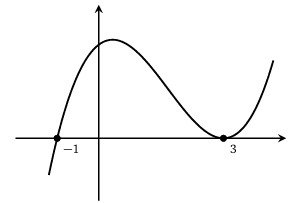
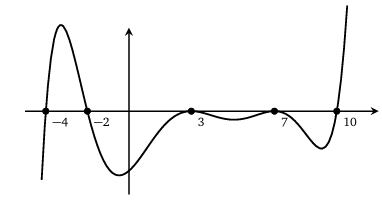
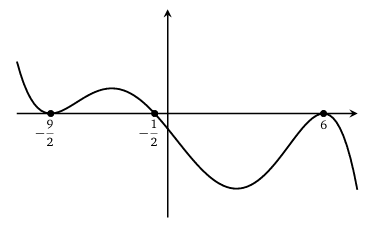
As illustrated in the figures, the behavior of a graph at an intercept reveals the multiplicity of the root. If the graph intersects the $x$-axis directly without turning or flattening, there is a single root at that value. If the graph touches the $x$-axis and turns (is tangent), this indicates a double root. If the graph flattens as it crosses the $x$-axis, it indicates a triple root.

The degree of the polynomial corresponds to the exponent of the leading term in the expanded form. For polynomials of even degree, the end behavior is the same on both sides; for odd degree, the end behavior differs. Additionally, if the leading coefficient is negative, the standard end behavior is reversed.
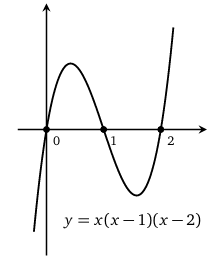
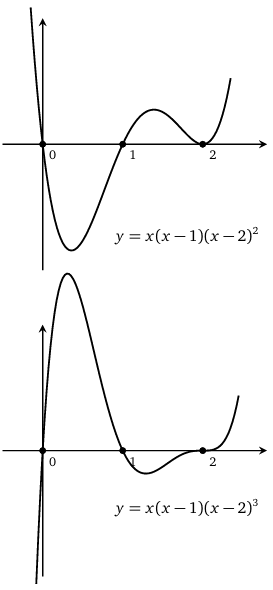
Description
Description
14. What function is graphed here? 3
Description
  1. $y=(x+1)(x-3)$
  2. $y=(x+1)(x-3)^2$
  3. $y=x(x+1)(x-3)^2$
  4. $y=(x+1)^2(x-3)$

Show correct answer

B

15. What function is graphed here? 4
Description
  1. $y=(x+4)(x+2)(x-3)^2(x-7)^2(x-10)^2$
  2. $y=(x+4)(x+2)^2(x-3)^2(x-7)^2(x-10)$
  3. $y=(x+4)^2(x-3)^2(x-7)^2(x-10)$
  4. $y=(x+4)(x+2)(x-3)^2(x-7)^2(x-10)$

Show correct answer

D

16. What could be the equation graphed here? 4
Description
  1. $y=-(2x+9)^2(2x+1)(x-8)^2$
  2. $y=(2x+9)^2(2x+1)(x-6)$
  3. $y=-(2x+9)^2(2x+1)(x-6)^2$
  4. $y=(2x+9)^2(2x+1)(x-6)^2$

Show correct answer

C

Finding Polynomial Coefficients

The Factor Theorem can be used to determine unknown coefficients in a polynomial. For example, suppose that $x+5$ is a factor of the cubic polynomial $x^3+2x^2+3x+k$. To find the value of the constant $k$, substitute the root $x=-5$ into the expression and set it to zero: \begin{align*} & (-5)^3+2(-5)^2+3(-5) +k=0 \\ \implies & -125+50-15+k=0 \\ \implies & -90+k=0 \\ \implies & k=90. \end{align*}

17. If $x+2$ is a factor of $x^3+2x^2+3x+k$, what is the value of $k$? 4
  1. $8$
  2. $10 $
  3. $ -4 $
  4. $ 6$

Show correct answer

D

18. What is the value of $v$ such that $x+3$ is a factor of $x^3+3x^2+vx-12$?4
  1. $ 4$
  2. $2$
  3. $-4$
  4. $-2 $

Show correct answer

C

Coefficients From Expansion

To find the coefficients in a binomial expansion, apply the Binomial Theorem: $$ (x+y)^n = \sum_{k=0}^n {}_{n}\mathrm{C}_{k} x^{n-k}y^k. $$ Substituting the values for $(x+5)^4$ yields: \begin{align*} &(x+5)^4 \\ = \ & {}_{4}\mathrm{C}_{0}x^4+ {}_{4}\mathrm{C}_{1}x^3\cdot5+ {}_{4}\mathrm{C}_{2}x^2\cdot5^2+ {}_{4}\mathrm{C}_{3}x\cdot5^3 \\ & + {}_{4}\mathrm{C}_{4}x^0\cdot5^4 \\ = \ & 1\cdot x^4+4\cdot x^3\cdot5+ 6\cdot x^2\cdot5^2+4\cdot x\cdot5^3+5^4 \\ = \ & x^4+20x^3+150x^2+500x+625. \end{align*} Mastery of the Binomial Theorem is advantageous for high-scoring students. However, exam questions likely involve exponents small enough to permit manual expansion.

Certain problems may not require the full theorem, such as finding the coefficient of the $x^5$ term in $(2x + 7)^5$. Since this corresponds to the leading term, simply raise the variable term to the given power: $$ (2x)^5 = 32x^5 $$ The coefficient is 32.

19. What is the coefficient of the $x^5$ term in ${(2x+5)}^5$?3
  1. $ 16$
  2. $ 32$
  3. $ 80$
  4. $125$

Show correct answer

B

20. What is the coefficient of the $x^3$ term in the expansion of $(x+1)^6$? 4
  1. $18$
  2. $20$
  3. $24$
  4. $30$

Show correct answer

B

Answer key: 1.D, 2.B, 3.A, 4.C, 5.C, 6.B, 7.D, 8.B, 9.A, 10.A, 11.B, 12.B, 13.D, 14.B, 15.D, 16.C, 17.D, 18.C, 19.B, 20.B,


Solutions

1.(D) Expand using the perfect square formula $(a-b)^2 = a^2-2ab+b^2$: $$ (5x)^2 - 2(5x)(4y) + (4y)^2 = 25x^2-40xy+16y^2. $$ Avoid the common error of squaring each term rather than expanding the binomial completely.
2. (B) Expand using the perfect square formula $(a+b)^2 = a^2+2ab+b^2$: $$ \left(\dfrac{x}{3}\right)^2 + 2\left(\dfrac{x}{3}\right)\left(\dfrac{y}{5}\right) + \left(\dfrac{y}{5}\right)^2 = \dfrac{x^2}{9}+\dfrac{2xy}{15}+\dfrac{y^2}{25}. $$ Avoid the common error of squaring each term rather than expanding the binomial completely.
3. (A) Expand using the perfect square formula to isolate the middle term: $$ \left(\dfrac{x}{3}\right)^2 + 2\left(\dfrac{x}{3}\right)(4y) + (4y)^2 = \dfrac{x^2}{9}+\dfrac{8xy}{3}+16y^2. $$ The middle term is $\dfrac{8xy}{3}$. Avoid the common error of squaring each term rather than expanding the binomial completely.
4. (C) Expand the expression using the perfect square formula: $$ \left(2x+ \dfrac{1}{2}\right)^2=4x^2+2x+\dfrac{1}{4}. $$
5. (C) Rearrange the equation to set it to zero: $$ 4x^5 - 30x^4 = 0. $$ Factor out the common term $2x^4$: $$ 2x^4(2x - 15) = 0. $$ Set each factor to zero to solve for $x$: $$ 2x^4=0 \implies x=0 \quad \text{or} \quad 2x-15=0 \implies x=\dfrac{15}{2}. $$
6. (B) Rearrange the equation to set it to zero: $$ 4x^3 - 25x = 0. $$ Factor out $x$ and then factor the resulting difference of squares: $$ x(4x^2 - 25) = 0 \implies x(2x-5)(2x+5)=0. $$ Set each factor to zero to find the roots: $$ x=0, \quad x=\dfrac{5}{2}, \quad x=-\dfrac{5}{2}. $$
7. (D) Factor out the common term $x^3$: $$ x^5+5x^4+4x^3 = 0 \implies x^3(x^2+5x+4) = 0. $$ Factor the quadratic expression: $$ x^3(x+4)(x+1) = 0. $$ Set each factor to zero to find the roots: $$ x=0, \quad x=-4, \quad x=-1. $$
8. (B) Factor out $x^2$: $$ x^4+5x^3+2x^2=0 \implies x^2(x^2+5x+2)=0. $$ The solutions are $x=0$ and the roots of the quadratic factor. Apply the quadratic formula: $$ x = \dfrac{-5\pm \sqrt{25- 8}}{2} = \dfrac{-5\pm \sqrt{17}}{2}. $$ Comparing the values, $\dfrac{-5- \sqrt{17}}{2}$ is the smallest solution.
9. (A) Perform synthetic division with the known root $x=3$ to factor the polynomial: $$ \begin{array}{r|rrrr} 3 & 1 & 8 & -29 & -12 \\ & & 3 & 33 & 12 \\\hline & 1 & 11 & 4 & 0 \end{array} $$ The quotient is $x^2+11x+4$. Solve the resulting quadratic equation using the quadratic formula: $$ x=\dfrac{-11\pm \sqrt{121- 16}}{2} \implies x=\dfrac{-11\pm\sqrt{105}}{2}. $$ Note: You can use long division instead of synthetic division, which yields the same quotient.
10.(A) Factor the expression by applying the difference of squares formula twice: $$ x^4 - 16 = (x^2+4)(x^2-4) = (x^2+4)(x+2)(x-2). $$ Note that $x^2+4$ cannot be factored further over the real numbers.
11. (B) Apply the difference of cubes formula $a^3 - b^3 = (a-b)(a^2+ab+b^2)$. Substitute $a=2x$ and $b=3$: $$ (2x)^3 - 3^3 = (2x-3)((2x)^2+(2x)(3)+3^2). $$ Simplify the terms: $$ (2x-3)(4x^2+6x+9). $$ Alternatively, solve $8x^3-27=0 \implies x=\dfrac{3}{2}$. Use synthetic division to find the remaining quadratic factor.$$
12. (B) Since $x=5$ is the only root of a third-degree polynomial, it must have a multiplicity of 3. The polynomial is $(x-5)^3$. Expand the expression: $$ (x-5)^3 = (x-5)(x^2-10x+25) = x^3-5x^2-10x^2+50x+25x-125 = x^3-15x^2+75x-125. $$ Alternatively, use the Binomial Theorem: $$ (x-5)^3 = {}_3C_0 x^3+{}_3C_1 x^2 (-5)+{}_3C_2 x (-5)^2+{}_3C_3 (-5)^3= x^3- 15x^2+75x- 125. $$
13. (D) Construct the polynomial from the factors $(x-5)$, $(x+2)$, and $(x-1)$: $$ (x-5)(x+2)(x-1) = (x^2-3x-10)(x-1). $$ Expand the expression: $$ x^3-3x^2-10x-x^2+3x+10=x^3-4x^2-7x+10. $$
14. (B) At $x = -1$, the graph crosses the $x$-axis directly. This indicates a root with odd multiplicity, corresponding to the factor $(x+1)$.At $x = 3$, the graph touches the $x$-axis and turns (is tangent). This indicates a root with even multiplicity, corresponding to the factor $(x-3)^2$.Combining these factors yields the function $y=(x+1)(x-3)^2$.
15. (D) Crossings: The graph crosses the $x$-axis at $x = -4$, $x = -2$, and $x = 10$. These correspond to factors with odd exponents: $(x+4)$, $(x+2)$, and $(x-10)$.Tangencies: The graph touches the $x$-axis at $x = 3$ and $x = 7$. These correspond to factors with even exponents (double roots): $(x-3)^2$ and $(x-7)^2$.End Behavior: The graph starts low ($y \to -\infty$) and ends high ($y \to \infty$), indicating an odd-degree polynomial with a positive leading coefficient.Combining these factors yields $y=(x+4)(x+2)(x-3)^2(x-7)^2(x-10)$.
16. (C) Roots: The graph touches the $x$-axis at $x = -\dfrac{9}{2}$ and $x = 6$, indicating even multiplicities (factors $(2x+9)^2$ and $(x-6)^2$). It crosses the $x$-axis at $x = -\dfrac{1}{2}$, indicating an odd multiplicity (factor $2x+1$).End Behavior: The graph starts high and ends low, which implies a negative leading coefficient.Combining these features yields the equation $y=-(2x+9)^2(2x+1)(x-6)^2$.
17. (D) Since $x+2$ is a factor, $-2$ is a root. Substitute $x=-2$ into the polynomial and set it equal to $0$, then solve for $k$: $$ (-2)^3 + 2(-2)^2 + 3(-2) + k = 0 \implies -8 + 8 - 6 + k = 0 \implies -6 + k = 0 \implies k = 6. $$
18. (C) Since $x+3$ is a factor, substitute $x=-3$ into the polynomial and set it equal to $0$ to solve for $v$: $$ (-3)^3+3(-3)^2+v(-3)-12=0 \implies -27+27-3v-12=0 \implies -3v=12 \implies v=-4. $$
19. (B) Identify the $x^5$ term by raising the first term of the binomial to the power of 5: $$ (2x)^5 = 32x^5 \implies \text{coefficient } = 32. $$
20. (B) By the Binomial Theorem, the term containing $x^3$ is given by ${}_6C_3 \cdot x^3 (1)^3$: $$ {}_6C_3 \cdot x^3 \cdot 1^3 = \dfrac{6 \cdot 5 \cdot 4}{3 \cdot 2 \cdot 1} x^3 = 20x^3. $$ The coefficient is 20. Multiplying out the entire expression to find the term in the $6^{th}$ degree polynomial is possible but lengthy.

Difficulty Key

  • 1 Easiest
  • 2 – 4 Intermediate
  • 5 Most Difficult
ACT math preparation with expert tutor guiding practice problems