Reasonable Rates

ACT Complex Numbers (2026)| Formulas, Practice & Study Guide

Complex numbers are a fundamental topic on the ACT Math test, appearing in questions about algebra, polynomial equations, and advanced problem-solving. Understanding how to work with imaginary numbers, complex conjugates, powers of i, multiplication, division, and quadratic equations will help you solve challenging ACT Math questions with confidence.

In this 2026 ACT Math study guide, you’ll learn the essential rules for complex numbers, explore step-by-step examples, and practice solving ACT-style questions. Whether you’re reviewing the basics or strengthening advanced skills, this guide will help you improve accuracy and boost your ACT Math score.

Complex Numbers

This is a topic for which difficult problems, intended to test reasoning ability, may appear.

Complex Conjugate

To find the complex conjugate, negate the imaginary part of a complex number. The product of a complex number and its conjugate is always a real number.For example, the conjugate of $3 - 2i$ is $3 + 2i$. Calculating their product yields: $$ (3 - 2i)(3 + 2i) = 9 + 6i - 6i - 4i^2 = 9 + 4 = 13. $$
1. What multiplied by $7-4i$ will result in a real number? 2
  1. $7+4i$
  2. $-7+4i$
  3. $i$
  4. $7-4i$

Show correct answer

A

2.Which of the following is equal to $\sqrt{(3+4i)(3 - 4i)}$ ? 3
  1. $-5$
  2. $5$
  3. $-\sqrt{7}$
  4. $\sqrt{7}$

Show correct answer

B

3. In complex numbers, what is $(2x+5i)(2x - 5i)$? 3
  1. $x^2+25$
  2. $4x^2 - 25$
  3. $4x^2+25$
  4. $4x^2+20ix - 25$

Show correct answer

C

Complex Powers

When raising complex numbers to positive integer powers, expand the expression and substitute $i^2 = -1$.

Consider the example $(2+i)^{-4}$. The most efficient approach is to first square $(2+i)$, square the result to obtain the fourth power, and finally calculate the reciprocal. To simplify the resulting fraction, multiply by the conjugate of the denominator.

First, square the binomial: $$ (2+i)^2 = 4 + 4i + i^2 = 3 + 4i. $$ Next, square the result to find the fourth power: $$ (2+i)^4 = (3+4i)^2 = 9 + 24i + 16i^2 = -7 + 24i. $$ Then, apply the negative exponent by taking the reciprocal: $$ (2+i)^{-4} = \dfrac{1}{(2+i)^4} = \dfrac{1}{-7+24i}. $$ Finally, rationalize the denominator (as detailed in the Complex Division section): \begin{align*} \dfrac{1}{-7+24i} \cdot \dfrac{-7-24i}{-7-24i} & = \dfrac{-7-24i}{(-7)^2 + (24)^2} \\ & = \dfrac{-7-24i}{625}. \end{align*}

4. Assuming $i^2=-1$, which of the following complex numbers is $(3+5i)^2$ in simplified form? 3
  1. $30i+41$
  2. $30i-20$
  3. $32i-16$
  4. $30i-16$

Show correct answer

D

5. Assuming $i^2=-1$, which of the following complex numbers is $(\sqrt{5}+i\sqrt{2})^2$ in simplified form? 4
  1. $3\pm2i\sqrt{10}$
  2. $3+2i\sqrt{10}$
  3. $6+2i\sqrt{10}$
  4. $3+4i\sqrt{5}$

Show correct answer

B

Large Complex Powers

To evaluate large powers of imaginary numbers, reduce the exponent modulo $4$. Recall the cyclic nature of imaginary powers: $$ i^1 = i, \quad i^2 = -1, \quad i^3 = -i, \quad i^4 = 1. $$ Consequently, powers of $i$ repeat in a cycle of $4$. This periodicity arises because $i$ is a fourth root of unity. For example: $$ i^{337} = i^1 = i \quad \text{because} \quad 337 \equiv 1 \pmod 4. $$ To determine the value of an integer modulo $4$, perform long division to find the remainder, or use a calculator to divide the integer by $4$ and multiply the resulting decimal portion by $4$. Alternatively, many scientific calculators offer a direct function to compute remainders.
6. If $i^n=-i$ and $i^2=-1$, what does $i^{n+7}$ equal? 3
  1. $-i$
  2. $i$
  3. $ -1 $
  4. $1 $

Show correct answer

C

7. If $k$ is a positive integer and $i^2=-1$, which of the following equals $i^{176k+3}$ in simplified form? 4
  1. $i$
  2. $-i$
  3. $1$
  4. $-1$

Show correct answer

B

8. What is $i^{20k-1}$ in simplified form, where $k$ is a positive integer and $i^2=-1$? 4
  1. $-i$
  2. $i$
  3. $1$
  4. $-1$

Show correct answer

A

9.Where $i^2=-1$, which of the following is $i^{-11}$ in simplified form? 4
  1. $-1$
  2. $-i$
  3. $i$
  4. 1

Show correct answer

C

Complex Multiplication

10. If $i=\sqrt{-1}$, which is equivalent to $(3+i)(5+2i)$? 3
  1. $17+11i$
  2. $17+13i$
  3. $17+20i$
  4. $13+11i$

Show correct answer

D

11. Which of the following is equivalent to $\big(2x -i\big)\big(2x+i\big)$? 3
  1. $2x^2+1$
  2. $4x^2 - 1$
  3. $4x^2+1$
  4. $4x^2+2$

Show correct answer

C

12. Which of the following is equivalent to $(3x+2i)^3$? 5
  1. $27x^3 - 54ix^2 -36x - 8i$
  2. $27x^3 - 54ix^2+36x - 8i$
  3. $27x^3+54ix^2 - 36x - 8i$
  4. $27x^3+54ix^2 - 12x - 8i$

Show correct answer

C

Complex Division

To divide complex numbers, multiply both the numerator and the denominator by the conjugate of the denominator. This process rationalizes the denominator.\begin{align*} \dfrac{2+3i}{5+2i} & = \dfrac{(2+3i)(5-2i)}{(5+2i)(5-2i)} \\ & = \dfrac{10-4i+15i-6i^2}{25-10i+10i-4i^2} \\ & = \dfrac{16+11i}{29}. \end{align*} This technique is analogous to rationalizing a denominator containing a radical, such as $\dfrac{1}{5+\sqrt{3}}$. Consider a more difficult example involving radicals: \begin{align*} \dfrac{1}{\sqrt{10}+ i\sqrt{6}} & = \dfrac{1(\sqrt{10}-i\sqrt{6})}{(\sqrt{10}+i\sqrt{6})(\sqrt{10}- i\sqrt{6})} \\ & = \dfrac{\sqrt{10}-i\sqrt{6}}{10-i\sqrt{60}+i\sqrt{60}- 6i^2} \\ & = \dfrac{\sqrt{10}-i\sqrt{6}}{16}. \end{align*}
13. Which of the following is equivalent to $\dfrac{1}{2+i}$? 3
  1. $\dfrac{2-i}{3}$
  2. $\dfrac{2-i}{4}$
  3. $\dfrac{2-i}{5}$
  4. $\dfrac{2+i}{5}$

Show correct answer

C

14. Which of the following is equivalent to $\dfrac{2+3i}{5+2i}$? 4
  1. $\dfrac{4+11i}{29}$
  2. $\dfrac{4+11i}{21}$
  3. $\dfrac{16+11i}{29}$
  4. $\dfrac{16+11i}{21}$

Show correct answer

C

15. Where $i^2=-1$, which of the following complex numbers equals $\dfrac{i}{\sqrt{3}-i}$? 4
  1. $\dfrac{i\sqrt{3}+1}{4}$
  2. $\dfrac{i\sqrt{3}-1}{2}$
  3. $\dfrac{i\sqrt{3}-6}{4}$
  4. $\dfrac{i\sqrt{3}-1}{4}$

Show correct answer

D

16. Where $i^2=-1$, which of the following complex numbers equals $\dfrac{1}{a+bi}$? 4
  1. $\dfrac{a+bi}{a^2+b^2}$
  2. $\dfrac{a-bi}{a^2+b^2}$
  3. $\dfrac{a-bi}{a+b}$
  4. $\dfrac{-a-bi}{a^2+b^2}$

Show correct answer

B

17. If $x\cdot(2+i)^2=1$ and $i^2=-1$, what is $x$? 4
  1. $\dfrac{3+5i}{25}$
  2. $\dfrac{3-4i}{7}$
  3. $\dfrac{3+4i}{7}$
  4. $\dfrac{3-4i}{25}$

Show correct answer

D

Finding an Equation from its Complex Solutions

To find a polynomial equation given a complex root, recall that for polynomials with real coefficients, complex roots occur in conjugate pairs. Thus, if a complex number is a solution, its conjugate is also a solution. To construct the equation, subtract each root from $x$ to form binomial factors and calculate their product.\noindent For example, if $2-i$ is a solution, then $2+i$ is also a solution. Multiplying the corresponding factors yields: $$ (x-(2-i))(x-(2+i)) = ((x-2)+i)((x-2)-i). $$ Recognizing this as a difference of squares simplifies the expansion: $$ (x-2)^2 - i^2 = (x^2-4x+4) - (-1) = x^2-4x+5. $$ Note that the imaginary terms always cancel when multiplying factors derived from conjugate pairs. This process is analogous to finding equations with irrational roots.

Consider a problem asking for a fourth-degree polynomial with integer coefficients and roots $2+i$ and $3+i$. The conjugate roots must be $2-i$ and $3-i$. Multiply the quadratic factors corresponding to each pair: \begin{align*} P(x) = & \ [(x-2-i)(x-2+i)] \\ & \cdot [(x-3-i)(x-3+i)] \\ = & \ (x^2-4x+5)(x^2-6x+10) \\ = & \ x^4-6x^3+10x^2-4x^3+24x^2-40x \\ & + 5x^2-30x+50 \\ = & \ x^4-10x^3+39x^2-70x+50. \end{align*}

18. Which of the following is a quadratic equation with a solution $4i$?3
  1. $x^2-16 = 0$
  2. $x^2+4 = 0$
  3. $x^2+8 = 0$
  4. $x^2+16 = 0$

Show correct answer

D

19. Which of the following quadratic equations has a solution $8-5i$?4
  1. $x^2-16x+85=0$
  2. $x^2-16x+87=0$
  3. $x^2-16x+91=0$
  4. $x^2-16x+89=0$

Show correct answer

D

Finding Complex Solutions

For polynomial equations of degree three or higher, factor the expression to isolate quadratic factors. Then, apply the quadratic formula to determine the complex solutions. For quadratic equations, use the quadratic formula directly or the method of completing the square.

When using the quadratic formula, a negative discriminant (the value under the radical) yields an imaginary term and, consequently, a complex solution. Similarly, when completing the square, equating a perfect square to a negative constant requires taking the square root of a negative number.

For example, solve $x^2 + 8x + 20 = 0$. Using the quadratic formula: \begin{align*} x & = \dfrac{-8 \pm \sqrt{8^2 - 4(1)(20)}}{2} \\ & = \dfrac{-8 \pm \sqrt{64 - 80}}{2} \\ & = \dfrac{-8 \pm \sqrt{-16}}{2} \\ & = \dfrac{-8 \pm 4i}{2} \\ & = -4 \pm 2i. \end{align*} Alternatively, by completing the square: \begin{align*} & x^2 + 8x = -20 \\ \implies & x^2 + 8x + 16 = -20 + 16 \\ \implies & (x + 4)^2 = -4 \\ \implies & x + 4 = \pm 2i \\ \implies & x = -4 \pm 2i. \end{align*}

20. What are the complex solutions of $x^2+10=0$? 3
  1. $\pm 100$i
  2. $\pm 10$i
  3. $\pm \sqrt{10}$i
  4. $\sqrt{10}$i

Show correct answer

C

21. What are the complex solutions of $x^2-4x+13=0$? 4
  1. $2\pm \sqrt{3}$
  2. $-2\pm 3i$
  3. $-2\pm 2i\sqrt{3}$
  4. $2\pm 3i$

Show correct answer

D

22. What are the complex solutions of $5^{x^2+3}=25$? 4
  1. $3i$ and $-3i$
  2. $2i$ and $-2i$
  3. $i$ and $-i$
  4. $1+i$ and $1-i$

Show correct answer

C

23. What is the solution set of $x^3+25x=0$ over complex numbers? 4
  1. $\{0,5i,-5i\}$
  2. $\{0,5i\}$
  3. $\{5i,-5i\}$
  4. $\{0,-5i\}$

Show correct answer

A

Factored Form

The exam may require an expression to be presented in factored form rather than as an expanded high-degree polynomial. If a complex root is given, determine the irreducible quadratic factor corresponding to that root and its conjugate, using the method described previously.
24. Which of the following is the factored form of a polynomial with roots $\dfrac{1}{5}$, $-\dfrac{3}{7}$, $\dfrac{8}{3}$, and $5i$? 4
  1. $(x^2+25)(3x-8)(5x+1)(7x-3)$
  2. $(x^2+25)(3x-8)(5x+1)(7x+3)$
  3. $(x^2+25)(3x-8)(5x-1)(7x+3)$
  4. $(x^2+5)(3x+8)(5x+2)(7x+3)$

Show correct answer

C

Square Roots of Negative Numbers

Convert expressions involving square roots of negative numbers into imaginary numbers before performing arithmetic operations. Typically, this process results in terms sharing a common radicand, which can then be added, subtracted, or divided like variables.
25. Which of the following is equivalent to $\sqrt{-50}+\sqrt{-18}$ ? 3
  1. $4i\sqrt{2}$
  2. $8i\sqrt{2}$
  3. $8\sqrt{2}$
  4. $16i\sqrt{2}$

Show correct answer

B

26. Using complex arithmetic, what is $\sqrt{-50}\cdot\sqrt{-18}$ ? 3
  1. $-36$
  2. $-32$
  3. $-30$
  4. $-25$

Show correct answer

C

27. In complex arithmetic, what is $(\sqrt{-75}-\sqrt{-12})^2$ 3
  1. $-36$
  2. $-27$
  3. $-18$
  4. $18$

Show correct answer

B

The Complex Plane

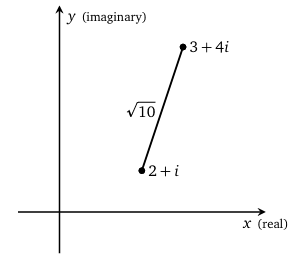
Complex numbers can be plotted on the complex plane, where the real part corresponds to the $x$-coordinate and the imaginary part corresponds to the $y$-coordinate. Some honors precalculus classes cover ways to convert these coordinates to polar form and use trigonometry to find roots of complex numbers. However, for this test, you only need to calculate the distance between complex numbers.

The distance between two complex numbers $a+bi$ and $c+di$ is determined by the distance formula: $$ \text{Distance} = \sqrt{(a-c)^2+(b-d)^2}. $$
Description
28. What is the distance in the complex plane between $-3-7i$ and $2-i$? 4
  1. $\sqrt{51}$
  2. $\sqrt{47}$
  3. $\sqrt{61}$
  4. $\sqrt{53}$

Show correct answer

C

29. What is the distance in the complex plane between $2+i$ and $(2+i)^2$? 4
  1. 3
  2. 4
  3. $\sqrt{11}$
  4. $\sqrt{10}$

Show correct answer

D

Other Complex Numbers Problems

30. Which of the following is NOT equivalent to $2i$? 3
  1. $\dfrac{\sqrt{8}}{\sqrt{-2}}$
  2. $\sqrt{-4}$
  3. $\dfrac{\sqrt{-36}}{3}$
  4. $(3+i)( -1+i)+4$

Show correct answer

A

31. Which expression is equivalent to $81x^2+49$? 3
  1. $(9x+7)(9x - 7)$
  2. $(9x+7)(9x+7)$
  3. $(9x+7i)(9x - 7i)$
  4. ${\left(9x+7i\right)}^2$

Show correct answer

C

32. Which $x$-value makes $y$ undefined in $y=\dfrac{x - 2}{4x^2+9}$? 3
  1. $\dfrac{3}{2}$
  2. $\dfrac{3i}{2}$
  3. $2$
  4. $2i$

Show correct answer

B

Answer key: 1.A, 2.B, 3.C, 4.D, 5.B, 6.C, 7.B, 8.A, 9.C, 10.D, 11.C, 12.C, 13.C, 14.C,
15.D, 16.B, 17.D, 18.D, 19.D,
20.C, 21.D, 22.C, 23.A, 24.C,
25.B, 26.C, 27.B, 28.C, 29.D, 30.A, 31.C, 32.B


Solutions

1.(A) Multiplying a complex number by its conjugate results in a real number. Determine the conjugate of $7-4i$ by negating the imaginary part, which yields $7+4i$.
2. (B) Expand the terms under the square root: $\sqrt{9 - 12i+12i - 16i^2} = \sqrt{9+16} = \sqrt{25} = 5$.
3. (C) Expand the expression: $4x^2 - 10ix+10ix - 25i^2=4x^2+25$.
4. (D) Expand the binomial:$$(3+5i)^2=(3+5i)(3+5i)=9+15i+15i+25i^2=30i-16.$$
5. (B) Expand the binomial: $$ (\sqrt{5}+i\sqrt{2})^2=5+2i\sqrt{10}+2i^2=3+2i\sqrt{10}. $$
6. (C) Apply exponent rules and substitute the given value $i^n=-i$: $$ i^{n+7}=i^n \cdot i^7=i^n \cdot i^4 \cdot i^3= (-i)(1)(-i) = i^2= -1. $$
7. (B) Recall that $i$ raised to a multiple of 4 equals 1. Since $176$ is a multiple of 4, simplify the expression: $i^{176k+3}=i^3=-i$.
8. (A) $i$ raised to a multiple of 4 equals 1. Since $20$ is a multiple of 4, simplify the expression: $$ i^{20k-1}=i^{-1}=i^{-1}\cdot i^4=i^3=-i. $$
9. (C) Rewrite with a positive exponent and simplify: $$ i^{-11}=\dfrac{1}{i^{11}}=\dfrac{1}{i^3}=\dfrac{1}{-i}=\dfrac{1\cdot i}{(-i)\cdot i}=i. $$ Alternatively, multiply by $i^{12}$ (since $i^{12}=1$): $i^{-11}\cdot i^{12}=i^1=i$.
10. (D) Expand the expression: $15+6i+5i+2i^2=15+11i - 2=13+11i$.
11. (C) Expand the expression: $4x^2 - 2xi + 2xi - i^2 = 4x^2 - i^2 = 4x^2 + 1$.
12. (C) First, expand the square: $$ (3x+2i)(3x+2i)=9x^2+12ix - 4. $$ Next, multiply the result by $(3x+2i)$: \begin{align*} (9x^2+12ix - 4)(3x+2i) & = 27x^3+18ix^2+36ix^2 - 24x - 12x - 8i \\ & = 27x^3+54ix^2 - 36x - 8i. \end{align*} Alternatively, apply the Binomial Theorem.
13. (C) Multiply the numerator and denominator by the conjugate of the denominator, then expand the terms: $$ \dfrac{2-i}{(2+i)(2-i)}=\dfrac{2-i}{4-i^2}=\dfrac{2-i}{5}. $$
14. (C) Multiply the numerator and denominator by the conjugate of the denominator, then expand the terms: $$ \dfrac{(2+3i)(5-2i)}{(5+2i)(5-2i)}= \dfrac{10 - 4i+15i- 6i^2}{25+10i-10i -4i^2}= \dfrac{16+11i}{29}. $$
15. (D) Multiply the numerator and denominator by the conjugate of the denominator: $$ \dfrac{i}{\sqrt{3}-i}\cdot\dfrac{\sqrt{3}+i}{\sqrt{3}+i}=\dfrac{i\sqrt{3}-1}{4}. $$
16. (B) Multiply the numerator and denominator by the conjugate of the denominator: $$\dfrac{1}{a+bi}\cdot\dfrac{a-bi}{a-bi} =\dfrac{a-bi}{a^2+abi-abi-b^2i^2} =\dfrac{a-bi}{a^2+b^2}. $$
17. (D) First, expand the squared term to get $x(3+4i)=1$. Then, isolate $x$ and multiply by the conjugate of the denominator: $$ x=\dfrac{1}{3+4i}\cdot\dfrac{3-4i}{3-4i}=\dfrac{3-4i}{25}. $$
18. (D) The solutions are $4i$ and its conjugate $-4i$. Form the equation by multiplying the factors $(x - 4i)$ and $(x + 4i)$: $$ (x - 4i)(x + 4i) = x^2 - 16i^2 = x^2 + 16. $$
19. (D) Complex roots occur in conjugate pairs, so the other root is $8+5i$. Form the equation by multiplying the factors: $$ (x-8+5i)(x-8-5i) = ((x-8)+5i)((x-8)-5i) = (x-8)^2 - 25i^2 = x^2 - 16x + 89 = 0. $$
20. (C) Isolate $x^2$ and take the square root of both sides: $$ x^2 = -10 \implies x = \pm \sqrt{-10} \implies x = \pm i\sqrt{10}. $$
21. (D) Apply the quadratic formula with $a=1$, $b=-4$, and $c=13$: $$ x = \dfrac{-(-4)\pm \sqrt{(-4)^2-4(1)(13)}}{2(1)}=\dfrac{4\pm \sqrt{16-52}}{2}=\dfrac{4\pm \sqrt{-36}}{2}=\dfrac{4\pm 6i}{2}=2\pm 3i. $$
22. (C) Express both sides with the same base, then equate the exponents and solve for $x$: $$ 5^{x^2+3} = 5^2 \implies x^2+3 = 2 \implies x^2 = -1 \implies x = \pm i. $$
23. (A) Factor the polynomial and solve for $x$: $$ x^3+25x = x(x^2+25) = 0. $$ This yields $x=0$ or $x^2+25=0$. Solving the quadratic equation: $$ x^2 = -25 \implies x = \pm \sqrt{-25} = \pm 5i. $$ The solution set is $\{0, 5i, -5i\}$.
24. (C) Identify the conjugate root $-5i$ and form the quadratic factor: $(x-5i)(x+5i)=x^2+25$. Convert the fractional roots to integer-coefficient factors: $$ x=\frac{1}{5} \implies (5x-1), \quad x=-\frac{3}{7} \implies (7x+3), \quad x=\frac{8}{3} \implies (3x-8). $$ Combining these gives $(x^2+25)(3x-8)(5x-1)(7x+3)$.
25. (B) Simplify each radical using imaginary units, then sum the terms: $$ \sqrt{-50}+\sqrt{-18} = 5i\sqrt{2} + 3i\sqrt{2} = 8i\sqrt{2}. $$
26. (C) Simplify each radical using imaginary units, then multiply the terms: $$ \sqrt{-50}\cdot\sqrt{-18} = (5i\sqrt{2})(3i\sqrt{2}) = 15(2)i^2 = -30. $$
27. (B) Simplify the radicals inside the parentheses, then square the result: $$ (\sqrt{-75}-\sqrt{-12})^2 = (5i\sqrt{3}-2i\sqrt{3})^2 = (3i\sqrt{3})^2 = 9(3)i^2 = -27. $$
28. (C) Apply the distance formula to the points $(-3, -7)$ and $(2, -1)$: $$ \sqrt{(2-(-3))^2+(-1-(-7))^2}=\sqrt{5^2+6^2}=\sqrt{25+36}=\sqrt{61}. $$
29. (D) First, determine the coordinates of the second point by expanding the square: $(2+i)^2=3+4i$. Then, apply the distance formula between $(2,1)$ and $(3,4)$: $$ \sqrt{(3-2)^2+(4-1)^2}=\sqrt{1^2+3^2}=\sqrt{10}. $$
30. (A) Evaluate each option to find the non-equivalent value:
  1. $\dfrac{\sqrt{8}}{\sqrt{-2}}=\dfrac{2\sqrt{2}}{i\sqrt{2}}=\dfrac{2}{i}=-2i \neq 2i$.
  2. $\sqrt{-4}=2i$.
  3. $\dfrac{\sqrt{-36}}{3}=\dfrac{6i}{3}=2i$.
  4. $(3+i)(-1+i)+4 = -3+3i-i-1+4=2i$.
31. (C) Rewrite the sum of squares as a difference of squares by using the identity $i^2 = -1$: $$ 81x^2+49 = (9x)^2 - 49i^2 = (9x)^2 - (7i)^2. $$ Apply the difference of squares formula, $a^2-b^2=(a-b)(a+b)$: $$ (9x)^2 - (7i)^2 = (9x - 7i)(9x + 7i). $$ Alternatively, expand the options to verify the result.
32. (B) The expression is undefined when the denominator is zero. Set the denominator equal to zero and solve for $x$: $$ 4x^2 + 9 = 0 \implies x^2 = -\dfrac{9}{4} \implies x = \pm \sqrt{-\dfrac{9}{4}} = \pm \dfrac{3i}{2}. $$

Difficulty Key

  • 1 Easiest
  • 2 – 4 Intermediate
  • 5 Most Difficult
ACT math preparation with expert tutor guiding practice problems