The sum of the angles in a triangle is $180^\circ$, in a quadrilateral $360^\circ$.
3 In a quadrilateral the interior angles are $80^\circ$, $120^\circ $, $100^\circ$ and $x^\circ$. What is $x$? $x^\circ = 360^\circ-100^\circ-120^\circ-80^\circ=60^\circ$
If two sides of a triangle are congruent, then their opposite angles are also congruent.
3 In $\triangle ABC$, $AB=AC$ and $\angle A=36^\circ$. What is $\angle B$? $\angle B=\angle C$. $\angle B+\angle C =180^\circ- 36^\circ=144^\circ$. Therefore, $\angle B =\dfrac{144^\circ}{2}=72^\circ$.
4 How many degrees does the hour hand of a clock move between 4:20 and 5:40 PM? The time elapsed is 1:20. $\dfrac{360^\circ}{12}=30^\circ$ / hour. $30^\circ\cdot \dfrac{4}{3}=40^\circ$.
5 What is the angle between the hour and minute hands of a clock at 3:30? $\dfrac{360}{12}=30^\circ$ per hour. $60^\circ$ between 4 and 6. $\dfrac{30}{2}=15^\circ$ between the hour hand's position at 3:30 and 4. $60^\circ+15^\circ=75^\circ$.
An exterior angle of a triangle is equal to the sum of the opposite interior angles.
Circumference $=2\pi r$ and Area $=\pi r^2$, where $r$ is the radius. These formulas are generally not given, so it is best to know or memorize them.
3 , F , CThe diameter of a circle is 10; what is its area? $r=\dfrac{10}{2}=5$. Area $=\pi r^2=\pi 5^2=25\pi$ square units.
4 The circumference of a certain circle is 50 meters. What is its radius? $C=2\pi r$, $50=2\pi r\implies r=\dfrac{50}{2\pi}\implies r=\dfrac{25}{\pi}$ meters.
4 , F The circumference of a certain circle is $30\pi$. What is the area of that circle? $C=2\pi r\implies 30\pi=2\pi r\implies r=15$. Area $=\pi r^2=\pi 15^2=225\pi$ square units.
4 , F What is the area in square coordinate units of a circle with center $(5,7)$ which is tangent to the $y$-axis? The radius must be 5, so $\pi r^2=25\pi$ square units.
4 , F A circle with radius 5 is inside a circle with radius 6. What is the area inside the larger circle, but outside the smaller circle? Area $=\pi r^2$. $\pi 6^2- \pi 5^2=36\pi - 25\pi =11\pi$ square units.
4 What is the minimum number of 6-inch by 6-inch tiles needed to cover an 8 feet 6 inches by 11 feet 6 inches floor? 17 by 23 tiles = 391 tiles. Alternative solution: each tile is $\dfrac{1}{2}\times \dfrac{1}{2}$ feet, so $\dfrac{1}{4}$ square feet each. $8.5\cdot 11.5=97.75$. $\dfrac{97.75}{\dfrac{1}{4}}=391$ tiles.
4 Sally has a 6 foot by 8 foot rectangular deck. She wants to add the same amount to the length and width so as to double the area. How much should she add? $(6+x)(8+x)=2\cdot 48\implies$ $x^2+14x+48=96\implies x^2+14x- 48=0$. $\dfrac{-14\pm \sqrt{14^2- 4\cdot 1\cdot (-48)}}{2}=$ $\dfrac{-14\pm \sqrt{196+192}}{2}\approx \dfrac{-14\pm 19.7}{2}$. The positive solution is $\dfrac{5.7}{2}\approx 2.9$ feet.
3 , C ,F What is the area of a right triangle with sides 5, 12, and 13? Since this is a right triangle, the two shorter sides are the legs or the base and height: $5\cdot \dfrac{12}{2}=30$.
4 , F One diagonal of a rhombus is of length 10 and the other of length 6. What is the area of the rhombus? $\dfrac{d_1\cdot d_2}{2}=\dfrac{10\cdot 6}{2}=30$. You could also find the area of each of 4 triangles (which are right and the same, since the diagonals of a rhombus are perpendicular) and multiply by 4.
5 What is the area of a rhombus with side lengths 6 and 2 angles measuring $60^\circ$? It can be divided into two equilateral triangles with sides 6. The area of an equilateral triangle is $\dfrac{s^2\sqrt{3}}{4}=\dfrac{6^2\sqrt{3}}{4}=9\sqrt{3}$, so both together are $18\sqrt{3}$. You can also find the height by the Pythagorean Theorem or $30-60-90$ triangles. Alternative Solution: one diagonal of the rhombus is 6. The other is $3\sqrt{3}\cdot 2=6\sqrt{3}$. The area of a rhombus is $\dfrac{d_1\cdot d_2}{2}=\dfrac{6\cdot 6\sqrt{3}}{2}=18\sqrt{3}$.
4 A large cube has side lengths 5 times those of a small cube. The volume of the large cube is how many times the volume of the small cube? $5^3=125$.
4 A cube has surface area $294$ square inches. What is the surface area of one face of the cube? $\dfrac{294}{6}=49$ square inches.
The formula for the volume of a box is $\text{length}\times \text{width}\times \text{height}$.
3 A rectangular solid is $\dfrac{1}{3}$ foot by 12 feet by 8 feet. How many cubic feet is its volume? $\dfrac{1}{3}\cdot 12\cdot 8=4\cdot 8=32$ cubic feet.
3 A rectangular box has sides 12 times that of a scale model of it. What is the ratio of the volume of the box to the volume of the model? $12^3=1728$.
4 A box has length 8~cm, width 6~cm and height 20~cm. If 384 cubic cm of sand are poured into the box, how deep will the sand be? $\dfrac{384}{6\cdot 8}=8$~cm.
4 A box is 12 meters by 6 meters by 10 meters. If it is filled to 75% capacity, how many cubic meters of material does it contain? $12\cdot 6\cdot 10=720$. $720\cdot .75=540$ cubic meters.
4 How many 4-inch by 6-inch by 8-inch boxes will fit into a 2 feet by 3 feet by 4 feet large box? The small box is $\dfrac{1}{3}\cdot \dfrac{1}{2}\cdot \dfrac{2}{3}$ cubic feet $=\dfrac{1}{9}$ cubic feet. The large box has volume $2\cdot 3\cdot 4=24$ cubic feet. $\dfrac{24}{\dfrac{1}{9}}=216$. You could also use cubic inches, but the numbers would be larger.
4 An inflatable bed has dimensions 50 inches by 80 inches by 8 inches. If it is inflated at the rate of 50 cubic inches per minute, how many minutes will it take to inflate? $50\cdot 80\cdot 8=32,000$ cubic inches. $\dfrac{32,000}{50}=640$ minutes.
The volume of a cylinder is $\pi r^2 h$.
4 A cylinder has height 12 and diameter 12. What is its volume? Radius $=\dfrac{12}{2}=6$. Volume$=\pi\cdot 6^2\cdot 12=432\pi$ cubic units.
5 A cylindrical can has height 8 inches and inside diameter 6 inches. If the contents of that can is poured into a cylinder with diameter 10 inches, how high will it be? Volume$=\pi r^2 h=\pi 3^2\cdot 8=72\pi$. The larger container was $V=\pi r^2 h\implies 72\pi=\pi 5^2 h\implies h=\dfrac{72}{25}$.
The formula for the volume of a sphere is $\dfrac{4\pi r^3}{3}$.
4 If the radius of a sphere is 5~cm, which is closest to its volume? $\dfrac{4\pi 5^3}{3}=\dfrac{500\pi}{3}\approx 524$ cubic cm.
If a square, rectangle, or right triangle is inscribed in a circle, its diagonal or hypotenuse is the diameter of the circle. The radius is half the diameter. Using that, you can find the area or circumference of the circle. That will allow you to determine the area inside the circle and outside the rectangle, etc.
3 ,F A 5 by 12 rectangle is inscribed in a circle. What is the area of the circle? The diagonal of the rectangle is $\sqrt{5^2+12^2}=13$. The radius of the circle is therefore $\dfrac{13}{2}$. The area of a circle is $\pi r^2=\pi \left(\dfrac{13}{2}\right)^2=\dfrac{169\pi}{4}$.
5 , F A square is inscribed in a circle of area $64\pi$. What is the area of the square? $\pi r^2=64\pi\implies r^2=64\implies r=8$. The diagonal of the square is therefore $16$. Therefore, the sides of the square are $8\sqrt{2}$. The area of a square is ${\left(8\sqrt{2}\right)}^2=128$.
The general formula will find the area of any triangle given 2 sides and their included angle. It is area $=\dfrac{\sin A\cdot AB\cdot AC}{2}$. For a right triangle, it reduces to $\dfrac{\text{base}\cdot \text{height}}{2}$, as the sin $90^\circ$ is 1.
4 , F , T In triangle $ABC$, angle $A$ is $30^\circ$, $AB$ is $3$ and $AC$ is $5$. What is the area of the triangle? $\sin 30^\circ\cdot 3\cdot \dfrac{5}{2}=\dfrac{1}{2}\cdot 3\cdot \dfrac{5}{2}=\dfrac{15}{4}$. Treating it as a $30-60-90$ triangle or $3-4-5$ right triangle would be falling into a trap.
To find the period, take $2\pi$ divided by the constant in front of $x$. The amplitude is the absolute value or the constant before the trigonometric function.
4 , C What is the amplitude and period of $y=5\sin(4x+\pi)$? Amplitude is 5; the period is $\dfrac{2\pi}{4}=\dfrac{\pi}{2}$.
4 , C For an angle with a measure of $\theta$ in a right triangle, $\sin \theta=\dfrac{2}{5}$. What is $\tan \theta$? $\text{adjacent}^2+2^2=5^2\implies$ $\text{adjacent}^2=21\implies \text{adjacent}=\sqrt{21}$. $$\tan\theta=\dfrac{\text{opposite}}{\text{adjacent}}=\dfrac{2}{\sqrt{21}}.$$ Alternate solution: $\sin^2 \theta+\cos^2 \theta=1\implies$ $$ \left(\dfrac{2}{5}\right)^2+\cos^2 \theta=1\implies \dfrac{4}{25}+\cos^2 \theta=1\implies \cos^2 \theta=\dfrac{21}{25}\implies \cos\theta=\dfrac{\sqrt{21}}{5}.$$ $$\tan\theta=\dfrac{\sin\theta}{\cos\theta}= \dfrac{\dfrac{2}{5}}{\dfrac{\sqrt{21}}{5}}=\dfrac{2}{\sqrt{21}}.$$ You can also use $1+\cot^2=\csc^2$ or take $\sin^{-1}$ with your calculator and then take tan of that angle.
3 , C If $\sin x =\dfrac{24}{25}$ and $\tan x=\dfrac{24}{7}$, what is $\cos x$?, $\tan x=\dfrac{\sin x}{\cos x}\implies \cos x=\dfrac{\sin x}{\tan x}$, Therefore, $$\cos x=\dfrac{\dfrac{24}{25}}{\dfrac{24}{7}}=\dfrac{7}{25}.$$
3 , C In triangle $ABC$, angle $A$ is a right angle, $AB=4$ and $AC=5$. What is $\sin B$? ${BC}^2=4^2+5^2$ by the Pythagorean theorem $\implies {BC}^2=16+25=41\implies BC=\sqrt{41}$. $$\sin B=\dfrac{\text{opposite}}{\text{hypotenuse}}= \dfrac{AC}{BC}=\dfrac{5}{\sqrt{41}}.$$
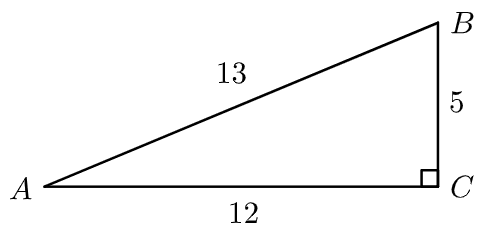
In $\triangle ABC$, what is $\cos A$?$\cos A=\dfrac{\text{adjacent}}{\text{hypotenuse}}=\dfrac{12}{13}$.
This involves basic right triangle trigonometry, which is often taught in Geometry as well as Algebra II.$\sin=\dfrac{\text{opposite}}{\text{hypotenuse}},$ $\cos=\dfrac{\text{adjacent}}{\text{hypotenuse} },$$\tan=\dfrac{\text{opposite}}{\text{adjacent}}.$The hypotenuse is opposite the right angle and is also technically adjacent to the angle in question.
4 In triangle $ABC$, angle $C$ is a right angle, angle $A$ is $25^\circ$ and $AC=20$, what is $BC$? $\tan 25^\circ=\dfrac{x}{20}\implies x=20\tan 25^\circ\implies$ $x=20\cdot 0.466\implies x=9.32$.
Memorizing these formulas should NOT be a high priority. Questions on this are rare, and knowing the formulas is generally helpful but not absolutely necessary. $\sin (2\theta)=2\sin\theta\cos\theta$; $\cos (2\theta)={\cos}^2 \theta-\sin^2 \theta=2\cos^2\theta- 1= 1-2\sin^2\theta$; $\sin(\alpha+\beta)=\sin\alpha\cos\beta+\sin\beta\cos\alpha$; $\sin(\alpha-\beta)=\sin\alpha\cos\beta-\sin\beta\cos\alpha$; $\cos(\alpha+\beta)=\cos\alpha\cos\beta-\sin\alpha\sin\beta$; $\cos(\alpha-\beta)=\cos\alpha\cos\beta+\sin\alpha\sin\beta$.
4 , F If $\sin x=v$, what is equal to $\cos 2x$? $\cos 2x=1-2\sin^2x=1-2v^2$. They may give the basic form of the formula $\cos^2-\sin^2$, and you would need to derive the needed form if you didn't know it. This problem could also be solved by substituting a number for the angle.
You should know how to apply these and which one to use for a particular problem. You may or may not be given the formulas. Often you will need to find an expression using one of the laws rather than a numerical answer.Law of sines problems result in no solutions or two solutions, but those should NOT be on the exam. These formulas are for solving general triangles, which do not have right angles.
The law of sines is $\dfrac{\sin A}{a}=\dfrac{\sin B}{b}=\dfrac{\sin C}{c}$ or $\dfrac{a}{\sin A}=\dfrac{b}{\sin B}=\dfrac{c}{\sin C}$. This is a more precise formulation of the larger side is opposite the larger angle. Use the law of sines when you have a side and an opposite angle and one other piece of information.
The law of cosines is $c^2=a^2+b^2- 2ab \cos C$. $a$, $b$, and $c$ are interchangeable. This is a generalization of the Pythagorean theorem. Use the law of cosines when you have 2 sides and an included angle or all 3 sides. Another form of this formula is $\angle C=\arccos \dfrac{a^2+b^2- c^2}{2ab}$.
4 , C In $\triangle ABC$, $\angle A=40^\circ$, $\angle B=60^\circ$ and $AB=20$. What is $BC$?\\ Since the angles in a triangle add to $180^\circ$, $\angle C=80^\circ$. $\dfrac{BC}{\sin A}=\dfrac{AB}{\sin C}\implies \dfrac{BC}{\sin 40^\circ}=\dfrac{20}{\sin 80^\circ}\implies$ $\dfrac{BC}{0.64}=\dfrac{20}{0.98}\implies BC=20\cdot \dfrac{0.64}{0.98}=13.1$.
4 , C What is the smallest angle in a triangle with sides 2, 3, and 4? , $2^2=3^2+4^2- 2\cdot 3\cdot 4\cos C\implies 4=25- 24\cos C\implies \cos C=\dfrac{21}{24}\implies C=\arccos \dfrac{21}{24} \approx 29^\circ$.
$\log xy=\log+\log y$, $\log\dfrac{x}{y}=\log x-\log y$, $\log x^y=y\log x$, $\log_a a^b=b$
3 What is $\log_x \dfrac{x^7}{x^{22}}$?$\log_x \dfrac{1}{x^{15}}=\log_x x^{-15}=-15$.
3 Which is equivalent to $\log \left(\dfrac{a^2}{b}\right)$? $\log(a^2)-\log b=2\log a-\log b$.
3 What is the value of $(\log_3 27)(\log_2 64)$?$3\cdot 6=18$.
4 For $x>-1$, what is $\log(x+1)+\log(x+3)$?$\log((x+1)(x+3))=\log(x^2+4x+3)$.
4 If $\log x=c$ and $\log y=d$, what is $\log(x^2 y^5)$?$2\log x+5\log y=2c+5d$.
These are generally solved by raising both sides to the base of the log to eliminate the log expression. This is also called converting to exponential form.
3 What value satisfies $\log_x 81=4$? This can be solved intuitively or by reasoning. Algebraically, $x^4=81\implies x=\sqrt[4]{81}\implies x=3$.
3 If $\log_3 x=-4$, what is $x$? Taking both sides 3 to the power or converting to exponential form, $x=3^{-4}=\dfrac{1}{81}$.
3 If $\log_x \dfrac{1}{8}=-3$, what is $x$?$\dfrac{1}{8}=x^{-3}\!\implies\!\dfrac{1}{8}=\dfrac{1}{x^3}\!\implies \! x^3=8\!\implies\! x=2$.
4 For what value of $x$ is $\log_3 9^5=3x$?$\implies$ (taking both sides 3 to the power or converting to exponential form) $9^5=3^{3x}\implies 3^{10}=3^{3x}\implies 10=3x\implies x=\dfrac{10}{3}$.
5 For what real value of $x$, if any, does$\log_{x+2} (x^2+2)=2$ hold true? $x^2+2=(x+2)^2\implies x^2+2=x^2+4x+4\implies 4x= -2\implies x=\dfrac{-1}{2}$. Checking, $\log_{3/2}\left(\dfrac{9}{4}\right)=2\implies 2=2$. For many students, this problem can best be solved by plugging in the answer choices.
5 What is the solution to $\log_2\dfrac{\sqrt{4x-1}}{x- 1}=1$?Taking both sides 2 to the power or converting to exponential form, $\dfrac{\sqrt{4x-1}}{x-1}=2\implies$$\sqrt{4x-1}=2x- 2 \implies 4x-1=$$4x^2-8x+4\implies 4x^2- 12x+5=0\implies$$\dfrac{12\pm \sqrt{144- 80}}{8} \implies \dfrac{12\pm 8}{8}=\dfrac{20}{8}$ or$\dfrac{4}{8}=\dfrac{5}{2}$ or $\dfrac{1}{2}$. For $\dfrac{5}{2}$, $\log_2 \dfrac{\sqrt{4\cdot \dfrac{5}{2}- 1}}{\dfrac{5}{2}- 1}=1\implies$$\dfrac{\sqrt{10- 1}}{\dfrac{3}{2}}=2 \implies \dfrac{3}{\dfrac{3}{2}}=2$, which checks.
For $\dfrac{1}{2}$, $\log_2 \dfrac{\sqrt{4\cdot \dfrac{1}{2}- 1}}{\dfrac{1}{2}- 1}=2\implies \dfrac{\sqrt{1}}{\dfrac{-1}{2}}=2$$\implies -2=2$, which does not check. Therefore, the only solution is $\dfrac{5}{2}$.
4 If $\log 8=0.9$, what does $\log(8\times 10^{143})$ equal? $\log 8+\log 10^{143}=0.9+143=143.9$.
4 The number of decibels, $d$, is given by $d=10 \log \left( \dfrac{I}{10^{-12}}\right)$, where $I$ is the sound intensity. What sound intensity produces 80 decibels? $80=10 \log\left( \dfrac{I}{10^{-12}}\right)\implies$ $8=\log \left(\dfrac{I}{10^{-12}} \right)\implies$ $10^8=\dfrac{I}{10^{-12}}\implies I=10^8\cdot 10^{-12}=10^{-4}$.
The key property is $\mathrm{i}^2=-1$.
C , 2 A common problem is to expand and simplify $(5+2\mathrm{i})^2$. FOIL it out $(5+2\mathrm{i})(5+ 2\mathrm{i})=25+10\mathrm{i}+10\mathrm{i}+4\mathrm{i}^2=25+ 20\mathrm{i}-4=21+20\mathrm{i}$.
C , 2 What is $(3+4\mathrm{i})(2-5\mathrm{i})$? FOIL it out, $6-15\mathrm{i}+8\mathrm{i}-20\mathrm{i}^2=6-7\mathrm{i}+20=26- 7\mathrm{i}$. The main issues are to FOIL out and convert $\mathrm{i}^2$ to $-1$.
2 , C Another common problem is determining which complex number when multiplied by a nonzero complex number $a+8\mathrm{i}$ results in a rational number? You need to multiply by the complex conjugate, which is the same number but with the imaginary part made negative, so in this case $a- 8\mathrm{i}$. If the question asks for what times $c-d\mathrm{i}$ gives a rational number, the answer is $c+d\mathrm{i}$.
2 You might be asked to solve $x(4+5\mathrm{i})=1$. Then $x=\dfrac{1}{4+5\mathrm{i}}$. Now multiply the numerator and denominator by the conjugate of the denominator.$x=\dfrac{4- 5\mathrm{i}}{(4+5\mathrm{i})(4-5\mathrm{i})}=$ $\dfrac{4-5\mathrm{i}}{16-20\mathrm{i}+20\mathrm{i}- 25\mathrm{i}^2}=\dfrac{4-5\mathrm{i}}{41}$.
4 Another type of division problem is which is equivalent to $\dfrac{\mathrm{i}^4+\mathrm{i}^3}{\mathrm{i}+1}$? By substituting,$i^2 = -1$ and $i^4 = 1$, this is the fraction $\dfrac{1-\mathrm{i}}{1+\mathrm{i}}$. Now multiply the numerator and denominator by the conjugate of the denominator, $1-\mathrm{i}$: $\dfrac{(1-\mathrm{i})(1-\mathrm{i})}{(1+\mathrm{i})(1- \mathrm{i})}=\dfrac{1-\mathrm{i}-\mathrm{i}+\mathrm{i}^2}{1- \mathrm{i}+\mathrm{i}-\mathrm{i}^2}=$ $\dfrac{1-2\mathrm{i}- 1}{2}=\dfrac{-2\mathrm{i}}{2}=-\mathrm{i}$.
3 What is $\sqrt{-12}+\sqrt{-75}$?$2\mathrm{i}\sqrt{3}+ 5\mathrm{i}\sqrt{3}=7\mathrm{i}\sqrt{3}=\sqrt{-1}\cdot\sqrt{3} \cdot \sqrt{7^2}=\sqrt{-1\cdot 3\cdot 49}=\sqrt{-147}$.
5 A difficult problem is what quadratic equation has $3 + 2\mathrm{i}$ as a solution? It might be possible to solve each of the choices with the quadratic formula, but that is a time trap. The other solution must be the conjugate, $3-2\mathrm{i}$. Therefore, take $(x- (3 + 2\mathrm{i}))(x-(3-2\mathrm{i})) =(x-3-2\mathrm{i})(x- 3+2\mathrm{i})$. Now FOIL out and the imaginary terms cancel each other: $x^2- 3x+2\mathrm{i}x-3x+9-6\mathrm{i}-2\mathrm{i}x +6\mathrm{i}-4\mathrm{i}^2=x^2-6x+9+4=x^2-6x+13= 0$. If you were asked to find an equation with solution $7+\sqrt{3}$ (with an irrational but real number), you would use a similar approach.
4 , C , F What is the equation of a circle with center $(2, 5)$ going through $(-1,-1)$? By the distance formula, the radius of the circle is $\sqrt{(2+1)^2+(5+1)^2}=\sqrt{3^2+6^2}=\sqrt{45}$. Therefore, the equation of the circle is $(x- 2)^2+(y- 5)^2=45$.
5 What are the foci of $\dfrac{{(x- 6)}^2}{25}+\dfrac{{(y+2)}^2}{9} = 1$? $c^2=a^2- b^2\implies c^2=25- 9=16\implies c=4$. The center of the ellipse is $(6,-2)$, which can be determined by what is subtracted from $x$ and $y$. You go 4 from the center in either direction along the major axis. The major axis is the $x$-values, since $25>9$. Therefore, the foci are $(6-4,\,-2)$ and $(6+4,\,-2)\implies (2,\,-2)$ and $(10,\,-2)$ are the foci.
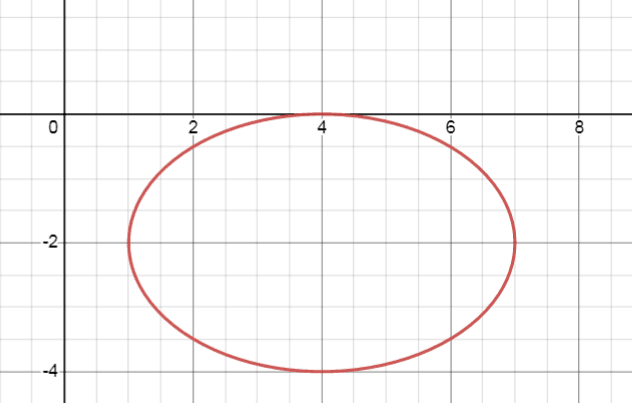
4 What is the equation of this ellipse? The center is $(4,-2)$. It extends 3 in the $x$ directions and 2 in the $y$ directions. Therefore, $\dfrac{{(x- 4)}^2}{9}+\dfrac{{(y+2)}^2}{4}=1$.
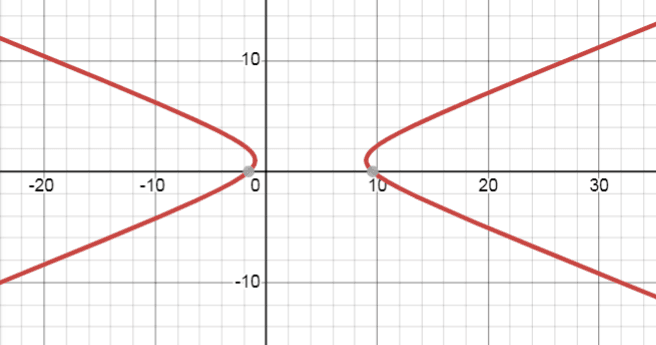
5 What is the equation of this hyperbola? The center is at $(4,1)$, by taking the average of the coordinates of the vertices. It opens in the $x$ direction, so the $x$ term is positive. The slopes of the asymptotes are about $\pm\dfrac{2}{5}$, so divide the $y$-term by $2^2=4$ and the $x-$term by $5^2=25$. The exact amount is hard to determine, but the various answer choices should be very different. Therefore, $\dfrac{{(x- 4)}^2}{25}- \dfrac{{(y- 1)}^2}{4}=1$.
3 What two terms can be placed in the blanks to make it an arithmetic sequence? 15, $\underline{\hspace{1cm}}$, $\underline{\hspace{1cm}}$, 51? $\dfrac{51-15}{3}=12$. Therefore, the terms are 27 and 39.
3 The $8^{th}$ term $a_8$ in an arithmetic sequence is 40 and the common difference is 3. What is the $1^{st}$ term? $a_1=a_8-7\cdot d=40-7\cdot 3=19$.
4 If the $3^{rd}$ term in an arithmetic sequence is $\dfrac{1}{2}$ and the $6^{th}$ term is $\dfrac{9}{8}$, what is the $10^{th}$ term? Common difference $=\dfrac{\dfrac{9}{8}- \dfrac{1}{2}}{6- 3}=\dfrac{\dfrac{5}{8}}{3}=\dfrac{5}{24}$. Therefore, $a_{10}=a_{6}+4\left(\dfrac{5}{24}\right)= \dfrac{9}{8}+\dfrac{5}{6}=\dfrac{54}{48}+ \dfrac{40}{48}=\dfrac{94}{48}=\dfrac{47}{24}$.
3 , C , C The first 5 terms of a geometric sequence are $-7$, 14, $-28$, 56, and $-112$. What is the $6^{th}$ term? The common ratio is $-2$. So the $6^{th}$ term is $-2\cdot (-112)=224$.
The formula for the sum of a geometric series is $\dfrac{a}{1- r}$, where $a$ is the first term and $r$ is the common ratio.
4 If the sum of a series is 100 and the common ratio is $\dfrac{2}{3}$, what is the $3^{rd}$ term in the series? $100=\dfrac{a}{1-\dfrac{2}{3}}\implies 100=\dfrac{a}{\dfrac{1}{3}}\implies a=\dfrac{100}{3}$.\smallskip $a_3 = \dfrac{100}{3}\cdot \left( \dfrac {2}{3}\right)^2=\dfrac{100}{3}\cdot\dfrac{4}{9}=\dfrac{400}{27}$.
With permutations order matters; while with combinations order does not matter. Therefore, there are more permutations than combinations. The formula for permutations is $\dfrac{n!}{(n -k)!}$ The formula for combinations is $\dfrac{n!}{n!\cdot(n -k)!}$, where you are choosing $k$ out of $n$ elements.
4 , C There are 9 players in a baseball starting lineup. The second baseman will bat first and the catcher will bat last. How many different possible lineups of those 9 players are there? 2 players are fixed, so we have 7 to arrange. $7! = 5040$.
4 How many ways can you arrange 7 different letters in 3 places? $_7P_3 =\dfrac{7!}{(7-3)!}=7\cdot 6\cdot 5=210$.
4 How many diagonals does an octagon have? The number of line segments connecting the 8 vertices is $_8C_2=\dfrac{8\cdot 7}{2}=28$. Subtract the 8 sides, so 20 diagonals.
3 , C Karen has 5 dresses, 4 blouses, and 10 pairs of shoes. How many outfits can she pick out? $5\cdot 4\cdot 10=200$ outfits.
These problems are generally easy.
1 , C Suppose there are 5 red, 7 blue, and 9 green marbles in a bowl. If a marble is drawn at random, what is the probability that it is NOT red? $\dfrac{7+9}{7+9+5}=\dfrac{16}{21}$.
OR condition probability problems on this exam are generally easy and should just require adding the probabilities, as they assume mutually exclusive events.
2 , C The probability of Event A occurring is $.3$ and the probability of Event B occurring is .2. These events are mutually exclusive. What is the probability that Event A or Event B occurs? $.3+.2=.5$
Take all the combinations that will give the requested value divided by the number of total combinations. For two dice, the number of total combinations is equal to the square of the number of faces on a single die.
4 If you roll two standard 6-sided dice, what is the probability that the total will be 4? This occurs with outcomes $1-3$, $3-1$, and $2-2$, so 3 possibilities out of $6^2=36$ total. Therefore, $\dfrac{3}{36}=\dfrac{1}{12}$.
4 If you roll two 8-sided dice numbered $1-8$, what is the probability that the total will be 10? This occurs with outcomes $2-8$, $8-2$, $3-7$, $7-3$, $4-6$, $6-4$ and $5-5$, so 8 possibilities out of $7^2=64$ total. Therefore, $\dfrac{7}{64}$.
In without replacement problems, reduce the number of the item drawn by one on the next draw and also reduce the number of total items by one.
3 For example, suppose there are 7 red marbles and 3 blue marbles in a bowl. If you draw two marbles without replacement, what is the probability they will both be red? $\dfrac{7}{10}\cdot \dfrac{6}{9}=\dfrac{42}{90}=\dfrac{7}{15}$.
4 Suppose there are 7 red marbles and 3 blue marbles in a bowl. If you draw two marbles without replacement, what is the probability one is red and the other is blue? $$\dfrac{7}{10}\cdot \dfrac{3}{9}+\dfrac{3}{10}\cdot \dfrac{7}{9}=\dfrac{42}{90}=\dfrac{7}{15}.$$ Here the number of possibilities of the other marble type is not reduced.
4 Suppose there are 6 red, 4 blue, and 2 yellow marbles in a bowl. If you draw two marbles without replacement, what is the probability both marbles will be of the same color?$$\dfrac{6}{12}\cdot \dfrac{5}{11}+\dfrac{4}{12}\cdot \dfrac{3}{11}+\dfrac{2}{12}\cdot \dfrac{1}{11}= \dfrac{30+12+2}{132}=\dfrac{44}{132}=\dfrac{1}{3}.$$
4 Seven slips of papers with numbers $1-7$ are placed in a bowl and two of them are drawn without replacement. What is the probability that the sum of the numbers will be 8? The possibilities are $1-7$, $7-1$, $2-6$, $6-2$, $3-5$ and $5-3$. The total possibilities are $7\cdot 6=42$. Therefore, $\dfrac{6}{42}=\dfrac{1}{7}$. Note that $4-4$ is not a possibility, as the numbers cannot repeat. Also note that the number of possibilities on the second draw is reduced by one.
5 Suppose there are 6 red, 4 blue, and 2 yellow marbles in a bowl. If you draw three marbles without replacement, what is the probability they will all be of different colors? $3!\cdot \dfrac{6\cdot 4\cdot 2}{12\cdot 11\cdot 10}=6\cdot \dfrac{48}{1320}=\dfrac{12}{55}$. We multiply by $3!$ because there are $3!$ arrangements of the 3 marbles. The number in the numerator is not reduced because the marbles are different colors.
Conditional probability is the probability that an event occurs given another event occurs.
4 40% of the balls in a bowl are red. 8% of the balls in that bowl are red and have a square on them. If a randomly drawn ball is red, what is the probability it has a square on it? $\dfrac{0.08}{0.4}=\dfrac{1}{5}$ or $0.2$.
4 One bowl contains slips of paper numbered $1-5$ and another contains slips of paper numbered $11-17$. If one slip of paper is taken at random from each bowl, what is the probability that the product of the numbers is odd? For the product to be odd, both numbers must be odd, so we multiply the probabilities. $\dfrac{3}{5}\cdot \dfrac{4}{7}=\dfrac{12}{35}$.
4 In one bowl are slips of paper numbered $1-5$ and in another slips of paper numbered $11-17$. If one slip of paper is taken at random from each bowl, what is the probability that the sum of the numbers is odd? For the sum to be odd, one must be odd and the other even. Therefore, $\dfrac{3}{5}\cdot \dfrac{3}{7}+\dfrac{2}{5}\cdot \dfrac{4}{7}=\dfrac{17}{35}$.
This is generally a precalculus topic, and you only need to know the basics.
3 , C Given the functions $f(x)=7x+2$ and $g(x)=x^2-4$, what is $f(g(-3))$? $g(-3)=(-2)^2 4=5$. $f(5)=7\cdot 5 + 2=37$. This is the easiest approach. You could also find $f(g(x))$ and then substitute $-3$ for $x$.
3 , C $f(x)=3x+5$ and $g(x)=x^2-3$. What is $f(g(4))$? It is better to substitute the constant 4 in first. $g(4)=4^2- 3=13$. $f(g(4))=f(13)=3\cdot 13+5=44$. Alternate solution $f(g(x))=3(x^2-3)+5=3x^2-4\implies f(g(4))=3\cdot 4^2-4=48-4=44$.
3 , C If $f(x)=2x- 5$ and $g(x)=x^2+3$, what is $f(g(x))$? $f(g(x))=2(x^2+3)-5=2x^2+6-5=2x^2+1$.
3 $f(x)=2x-5$ and $g(x)=3x+2$. What is $f(g(x))$? $2(3x+2)-5=6x+4-5=6x-1$.
4 $f(x)=x^2-25$ and $g(x)=x+2$. What are the solutions of $f(g(x))=0$? $(x+2)^2-25=0\implies x^2+4x-21=0\implies x=-7$ or 3. Alternative solution: $f(x)=0\implies x^2-25=0\implies x=-5$ or 5. Substitute $x+2$ for $x$ and get $-7$ or 3.
2 , C $f(x)=\dfrac{1}{x-4}$ and $g(x)=x^3$. What is $f(g(x))$? $\dfrac{1}{x^3-4}$
4 $f(x)=x^2+3x+2$ and $g(x)=x+4$. What is $f(g(x))$? $(x+4)^2+3(x+4)+2=x^2+8x+16+3x+12+2=x^2+11x+30$.
4 If $f(x)=2x+a$ and $g(x)=3x+5$, for what value of $a$ is $f(g(x))=g(f(x))$? $2(3x+5)+a=3(2x+a)+5\implies 6x+10+a=6x+3a+5\implies 5=2a\implies a=\dfrac{5}{2}$.
These problems are not common and generally involve solving for a variable and without explicitly asking to find the inverse function, Usually, they will be given with odd powers to avoid domain issues.
2 $y=4x+11$. What is $x$ in terms of $y$?Solve for $x$. $4x=y-11 \implies x=\dfrac{y- 11}{4}$.
2 What is the inverse function of $f(x)=x^5$? Switch $x$ and $y$ and then solve for $y$. $x=y^5\implies \sqrt[5]{x}=y= f^{-1}(x)$
3 $y=8x^3- 15$. Which is equivalent to $x$. Again, solve for $x$. $y+15=8x^3\implies \dfrac{y + 15}{8}=x^3\implies$ $\sqrt[3]{\dfrac{y+15}{8}}=x\implies x=\dfrac{\sqrt[3]{y+15}}{2}$
Most of these can also be solved by taking log or ln of both sides and solving the resulting linear equation with decimal coefficients.
3 $\dfrac{-1}{32}=-2^x$. What is $x$? $2^x=\dfrac{1}{32}\implies 2^x=2^{-5}\implies x=-5$.
3 If $2^x\cdot \dfrac{2^3}{({2^5})^6}=\dfrac{1}{16}$, what is $x$? $2^x\cdot \dfrac{2^3}{2^{30}}=\dfrac{1}{2^4}\implies$ $ \dfrac{2^x}{2^{27}}=\dfrac{1}{2^4}\implies 2^x=2^{23}\implies x=23$.
3 If $2^x\cdot 8=2^5$, what is $x$?$2^x\cdot 2^3=2^5\implies 2^x=2^2\implies x=2$.
4 $8^{x-3}=2$. What is $x$?${2^3}^{(x- 3)}=2^1\implies 3x- 9=1\implies$$3x=10\implies x=\dfrac{10}{3}$.
4 , C If $4^{5x+3}=8^{2x+7}$, what is $x$? ${2^2}^{(5x+3)}=2^{3(2x+7)}\implies$ $2^{10x+6}\!=\!2^{6x+21}\!\implies\! 10x+6=6x+21\!\implies$ $4x=15\implies x=\dfrac{15}{4}$. Alternate solution: $(5x+3)\log 4=(2x+7)\log 8$ (you could also use natural logarithms) $\implies (5x+3)0.6=(2x+7)0.9\implies 3x+1.8=1.8x+6.3\implies 1.2x=4.5\implies x=3.75$.
4 What real numbers satisfy $5^{x^2+3x-10}=1$? $5^{x^2+3x- 10}=5^0\implies x^2+3x- 10=0\implies x=-5$ or $2$ (by the quadratic formula or factoring).
4 If $8^{x^2}=4^{x+8}$, what could $x$ be? ${(2^3)^x}^2={2^2}^{(x+8)}\implies 3x^2=2x+16\implies$\smallskip $3x^2- 2x- 16=0$. $\dfrac{2\pm \sqrt{4+3\cdot 16\cdot 4}}{2\cdot 3}\implies$ \smallskip $\dfrac{2\pm \sqrt{196}}{6}\implies \dfrac{2\pm 14}{6}\implies \dfrac{8}{3}$ or $-2$. It is also possible to solve the quadratic equation by factoring. It is possible to use logarithms initially, but that is not the best approach.
3 , C The mass of a certain type of bacteria doubles every 15 minutes. How much will an initial sample of 5 mg be after 2 hours? There are 8 15-minute periods in 2 hours, so $5\cdot 2^8=5\cdot 256=1280$ mg.
4 How much will \$7000 invested at 5% interest compounded annually be after 20 years? $\$7000\cdot{1.05}^{20} = \$18,573$
To reflect about the $y$-axis, take the negative of the $x$-value; to reflect about the $x$-axis, take the negative of the $y$-value. Most reflection problems on this exam involve reflection about the $y$-axis.
2 , C What is the point $(-2,-4)$ reflected about the $y$-axis? Take the negative of the $x$-value, so $(2,-4)$.
2 What is the point $(-2,-4)$ reflected about the $x$-axis? Take the negative of the $y$-value, so $(-2,4)$.
4 What is the point $(-2,-4)$ reflected about the line $y=3$? The $y$-value is 7 below the line, so take 7 above the line, which is $3+7=10$. Therefore, $(-2,10)$.
4 , C What is the equation of $y=x^2$ shifted 5 left and 7 up? $y=(x+5)^2+7$.
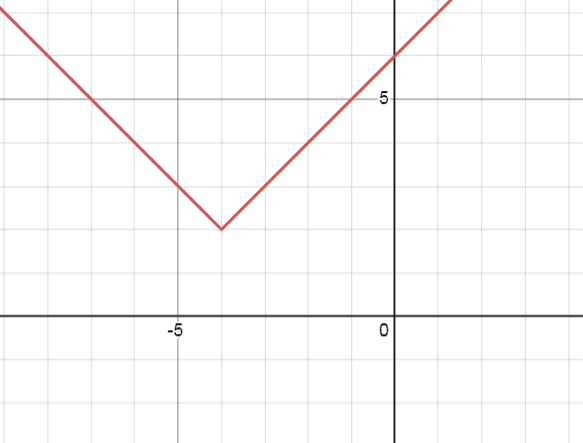
4 What is the equation graphed above?The vertex is at $(-4,2)$, so $y=|x+4|+2$.
$180^\circ$ rotation: $(-x,-y)$; $90^\circ$ clockwise: $(y,-x)$; $90^\circ$ counterclockwise: $(-y,x)$. General trigonometric formula $(x\cos \theta- y\sin \theta, x\cos\theta+y\sin\theta )$. These problems can also be solved by reasoning without knowing formulas.
4 , F What is the point $(5,2)$ rotated $180^\circ$? $(-5,-2)$
5 , F What is the point $(5,2)$ rotated $90^\circ$ counterclockwise? $(-2,5)
To find the vertical asymptote of a rational function, set the denominator equal to 0 and solve for $x$. To find the horizontal asymptote, if the numerator and denominator have the same degree, take the ratio of the highest order terms in the numerator and denominator. There are other rules for horizontal asymptotes, but all problems on the exam should have numerators and denominators of the same degree.
3 What is the vertical asymptote of $f(x)=\dfrac{3x+4}{2x+5}$? Set $2x+5=0\implies x=\dfrac{-5}{2}$.
3 , C What is the horizontal asymptote of $f(x) =\dfrac{3x+4}{2x+5}$? Since the degrees of the highest terms in the numerator and denominator are the same, take the ratio of the highest order terms: $\dfrac{3}{2}$, so $y=\dfrac{3}{2}$.
These are problems that involve evaluating a function or expression for a specific value of a variable.
1 , C If $f(x)=(5x+7)^2$, what is $f(1)$? Substituting 1 for $x$, $(5+7)^2=12^2=144$.
1 , C If $a=4$, $b=3$, and $c=5$, what is $(a+b-c)(b+c)$? Substituting for each variable, $(4+3-5)(3+5)=2\cdot 8=16$.
2 , C If $f(x,y)=3xy^2-x^2$, what is $f(5,4)$? Substituting for $x$ and $y$, $3\cdot 5\cdot 4^2-5^2=15\cdot 16- 25=215$.
2 What is the value of $x^2+xy+y^2-5$ when $x=2$ and $y=4$? $2^2+2\cdot 4+4^2-5=4+8+16-5=23$.
2 What is $2x^2y+3y^2z$ when $x=3$, $y=-2$ and $z=5$? $2\cdot 3^2\cdot(-2)+3\cdot (-2)^2\cdot 5=2\cdot 9\cdot (-2)+3\cdot 5\cdot 4=-36+60=24$.
2 What is the value of $\sqrt{\dfrac{b}{a-5}}$ when\smallskip $b=-10$ and $a=3$? $\sqrt{\dfrac{-10}{-2}}=\sqrt{5}$
Domain problems may explicitly ask for the domain, ask for the possible $x$-values, or ask for the $x$-values for which the expression is undefined. The key to many domain problems is to set the denominator equal to 0, and then any solution to that equation is excluded from the domain.
For other domain problems, what is under a radical to an even root must be $>= 0$ and what you are taking the log of must be $>0$.
2 For what values is $f(x)=\dfrac{(x+1)(x+2)}{(x+3)(x+4)(x+5)}$ undefined? Set the denominator equal to $0$. $(x+3)(x+4)(x+5)=0$. Therefore, $x=-3$, $-4$, and $-5$ are values for which the expression is undefined.
2 For what values is $f(x)=\dfrac{1}{x^3-64x}$ undefined? Set the denominator equal to 0. $x^3-64x=0\implies x(x^2- 64)=0$ (since this is a difference of squares) $\implies x(x- 8)(x+8)=0$. Therefore, it is undefined for 0, 8, and $-8$.
3 For what values is $f(x)=\dfrac{1}{|x|-7}$ undefined? Set $|x|-7=0$. Therefore, $x-7=0$ or $-x-7=0\implies x=7$ or $-7$.
3 What is the domain of $f(x) = \sqrt {5 - 2x}$?Set $5 -2x >= 0 \implies 5 >= 2x \implies \dfrac {5}{2} > x $
Range problems are uncommon and relatively difficult. They are usually best approached by graphing the function or expression and identifying the possible $y$-values from the graph.
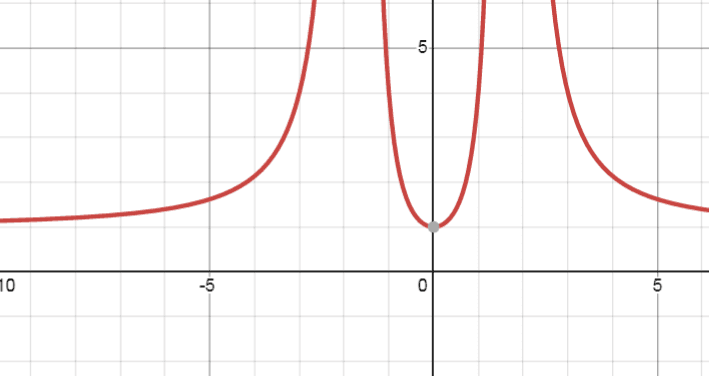
3 What is the range of $f(x)=\left(\dfrac{x^2+3}{x^2 - 3}\right)^2$? Determining what the graph looks like algebraically is too time consuming. One approach is to graph the expression with your calculator, and observe that the $y$-values appear to be $[1,\infty)$. Another is to see that the expression is squared, so the values must be non-negative.
3 What are possible $y$-values for $y=\dfrac{x}{x-3}$ for $x>3$? Graph the expression and verify that it appears to go from 1 to infinity for that domain. Or plug in answer choices for $y$ and see if the equation works. Also, you can see that $y$ goes to infinity as $x$ goes to 3 from above and $y$ goes to 1 as $x$ goes to infinity.
3 , C A bag contains 6 red marbles, 7 yellow marbles, and 9 blue marbles. How many additional red marbles must be added to the bag for the probability of drawing a red marble to be $\dfrac{3}{5}$? $\dfrac{6+x}{22+x}=\dfrac{3}{5}\implies 5(6+x)=3(22+x)\implies 30+5x=66+3x\implies 2x=36\implies x=18$.
3 , C If 500~ml of a 10% alcohol solution is mixed with 300 ml of a 40% alcohol solution, what percent alcohol is the resulting mixture? $\dfrac{500\cdot 0.1+300\cdot 0.4}{800}=\dfrac{50+120}{800}=\dfrac{170}{800}=0.2125$ or $\approx 21.3\%$.
5 How much 80% salt solution would you need to add to 8 liters of a 10% salt solution to make the mixture 30% salt? Set salt over liquid equal to 30%. $\dfrac{8\cdot 0.1+x\cdot 0.8}{8+x}=0.3\implies 0.8+0.8x=2.4+0.3x\implies 0.5x=1.6\implies x=3.2$ liters.
3 The Tigers have won 40\% of their first 30 games. How many games in a row would they need to win to increase their win percentage to 60%? $\dfrac{12+x}{30+x}=0.6\implies 12+x=18+0.6x\implies$ $0.4x=6\implies x=\dfrac{6}{0.4}=15$.
This is simple. Just add the corresponding elements of the matrices. To multiply by a scalar, multiply each element in a matrix by that scalar.
2 , C Which of the following matrices is equal to $\left[ \begin{array}{cc} 2 & -5 \\ 4 & 8 \end{array}\right]+\left[ \begin{array}{cc} 7 & 11 \\ -4 & -2 \end{array}\right]$?$\left[ \begin{array}{cc} 2+7 & -5+11 \\ 4+(-4) & 8+(-2) \end{array}\right]=\left[ \begin{array}{cc} 9 & 6 \\ 0 & 6 \end{array}\right]$
3 Which of the following is equivalent to $2\left[ \begin{array}{cc} 3 & 6 \\ -5 & 3 \end{array}\right]+5\left[ \begin{array}{cc} -5 & -2 \\ 2 & 3 \end{array}\right]$?First multiply$\left[ \begin{array}{cc} 6 & 12 \\ -10 & 6 \end{array}\right]+\left[ \begin{array}{cc} -25 & -10 \\ 10 & 15 \end{array}\right]=$$\left[ \begin{array}{cc} -19 & 2 \\ 0 & 21 \end{array}\right]$
It is important to understand how to perform matrix multiplication. You also should know that the number of columns in the first matrix being multiplied must equal the number of rows in the second one for the matrices to be multiplied. This is because you turn the rows of this first one on their side and multiply them by the columns of the second one.
4 $A=\left[ \begin{array}{c} 1 \\ 3 \end{array}\right]$ and $B=\left[ \begin{array}{cc} 5 & 4 \end{array}\right]$, what is $AB$? Turning $A$'s rows on their sides, $\left[ \begin{array}{cc} 5 & 4 \\ 15 & 12 \end{array}\right]$.
4 $A=\left[ \begin{array}{c} 1 \\ 3 \end{array}\right]$ and $B=\left[ \begin{array}{cc} 5 & 4 \end{array}\right]$, what is $BA$? Turning $B$ on its side, this is just one multiplication $\left[ \begin{array}{c} 1\cdot 5+3\cdot 4\end{array}\right]=\left[ \begin{array}{c} 17\end{array}\right]$.
4 $
A=\left[\!\!\begin{array}{ccc} 1 & 2 & 5 \\ 4 & 3 & 2 \end{array}\!\!\right]$ , $
B=\left[\!\!\begin{array}{ccc} 5 & 4 & 1 \\ 3 & 1 & 2 \\ 1 & 2 & 3\end{array}\!\!\right]$ What is $AB$?
$\left[\!\!\begin{array}{ccc}
1\!\cdot\! 5\!+\!2\!\cdot\! 3\!+\!5\!\cdot\!1 & 1\!\cdot\!4\!+\!2\!\cdot\! 1\!+\!5\!\cdot\!2 & 1\!\cdot\! 1\!+\!2\!\cdot\!2\!+\!5\!\cdot\!3
\\
4\!\cdot\!5\!+\!3\!\cdot\!3\!+\!2\!\cdot\!1 & 4\!\cdot\!4\!+\!3\!\cdot\! 1\!+\!2\!\cdot\!2 & 4\!\cdot\! 1\!+\!3\!\cdot\! 2\!+\!2\!\cdot\!3
\end{array}\!\!\right]$$=\left[ \begin{array}{ccc} 16 & 16 & 20 \\ 31 & 23 & 16 \end{array}\right]$.
4 $A=\left[ \begin{array}{ccc} 1 & 2 & 5 \\ 4 & 3 & 2 \end{array}\right]$ $B=\left[ \begin{array}{ccc} 5 & 4 & 1 \\ 3 & 1 & 2 \\ 1 & 2 & 3\end{array}\right]$
What is $BA$? The number of columns in $B$ does not equal the number of rows in $A$, so this multiplication is impossible.
The determinant of the matrix $\left[ \begin{array}{cc} a & b \\ c & d \end{array}\right]$ is $ad- bc$. They will typically not provide that formula.
3 , F What is the determinant of $\left[ \begin{array}{cc} 3 & 2 \\ 4 & 5 \end{array}\right]$? $3\cdot 5- 2\cdot 4=7$.
4 , F For what value of $x$ does the determinant of $\left[ \begin{array}{cc} 2 & 5 \\ x & 4 \end{array}\right]$ equal $3$?\\ $2\cdot 4- 5x=3\implies 8- 5x=3\implies\\ 5=5x\implies x=1$.
3 $y$ varies directly as $x$. If when $x=3$, $y=10$, then when $x=4$ what does $y$ equal?$y=kx$, $10=k3\implies k=\dfrac{10}{3}$. $y=\dfrac{10x}{3}$. $y=10\cdot \dfrac{4}{3}=\dfrac{40}{3}$.
4 $y$ varies directly as the square of $x$. When $x=3$ $y=20$. When $x=5$, what does $y$ equal? $y=kx^2$, plugging in values, $20=k3^2\implies k=\dfrac{20}{9}$. Substituting in for $k$, $y=\dfrac{20x^2}{9}$, substituting in $x=5$. $y=\dfrac{20\cdot 5^2}{9}=20\cdot \dfrac{25}{9}=\dfrac{500}{9}$.
4 How would you express algebraically that $x$ varies directly with $a$, inversely with the square of $b$, and directly with the cube of $c$? $x=\dfrac{kac^3}{b^2}$.
5 If force varies inversely with the square of distance, how far away would an object need to be for force to be twice as much as when it is 6~cm away? Let $F=24$. $F=\dfrac{k}{d^2}\implies 24=\dfrac{k}{6^2}\implies k=864$, so $F=\dfrac{864}{d^2}$. Twice $24$ is $48$, substituting, $48=\dfrac{864}{d^2}\implies d^2=18\implies d=3\sqrt{2} \approx 4.2$. It is also possible to solve this by reasoning and intuition. The distance would need to be reduced by $\sqrt{2}$, since $\sqrt{2^2}=2$.
Which of the following statements is equivalent to "If it is a table, then it is flat"? "If it is not flat, then it is not a table" is the contrapositive of the first statement. The contrapositive has the same truth value as the original. To get the contrapositive, take the negation of both portions of the original statement and switch their order.
About 68% of the data is within 1 standard deviation of the mean, about 95% of the date is within 2 standard deviations, and 99% is within 3 standard deviations.
4 If the mean age of 10 children is $m$ and the standard deviation is $s$, 8 years later what will the mean and standard deviation be? Mean $m+8$, standard deviation $s$.
4 The highest temperature recorded on the top of Mount Washington is $76^\circ$ Fahrenheit. The lowest is $108^\circ$ below zero. What are the range, median, and mean temperatures there? The range is $76-(-108)=184^\circ$. There is not enough information to determine the median or mean.
4 Set $A$ includes 10 numbers. Set $B$ includes 9 of the same numbers as $A$, but the largest number in Set $B$ is smaller than in $A$. Which measure must be less for $B$ than for $A$? The mean, range, and standard deviation must be less. The median will be the same.
4 There are 5 values in a data set. The largest value is greatly increased. What happens to the median and mean? The mean will be significantly increased. The median will be uneffected.
4 , C Of 40 people, 18 have only dogs, 12 have only cats and 4 have both. How many have neither? $40-18-12-4=6$.
3 What is the coefficient of the $x^4$ term in$(2x- 5)^4$? ${(2x)}^4=16x^4$, so $16$.
4 What is the coefficient of the $x^3$ term in $(x+1)^5$? $_5C_3=\dfrac{5!}{3!\cdot 2!}=\dfrac{5\cdot 4}{2}=10$.