The Classic Learning Test (CLT) is a standardized college entrance exam that measures students’ verbal reasoning, grammar and writing, and quantitative reasoning skills. The CLT is scored on a 1–120 scale and is accepted by more than 350 colleges and universities, including several state university systems and the U.S. Military Service Academies.
If you’ve ever wondered “what is the CLT exam ?” or how it compares to traditional exams, this guide will explain everything you need to know including the CLT vs SAT comparison, available CLT practice tests, and tips to prepare effectively.
1. What Is the Classic Learning Test (CLT)?
The Classic Learning Test (CLT) is a standardized college entrance exam that measures reading, writing, and math skills.

Unlike the SAT or ACT, which focus mainly on modern academic standards, the CLT emphasizes classic texts, logic, and moral reasoning.
The test was founded in 2015 by Classic Learning Initiatives, with the goal of restoring a more traditional and meaningful approach to academic assessment.
In short, the CLT test evaluates how well students can think critically, read deeply, and reason logically skills that are essential for higher education success.
Detailed Information on the CLT test dates 2026
2. CLT vs SAT: is the CLT easier than the SAT
When comparing CLT vs SAT, several major difference stand out And is CLT easier than SAT
The CLT focuses on classical literature, logic, and reasoning, while the SAT is centered around modern academic standards. Another difference is the format the CLT is fully online and can often be taken from home or at school, whereas the SAT is typically administered in person at testing centers.
CLT is accepted by more than 350 colleges and universities, with many partner institutions being private, liberal arts, and faith-based schools. Acceptance varies by institution, so students should always verify the current testing requirements of each college.
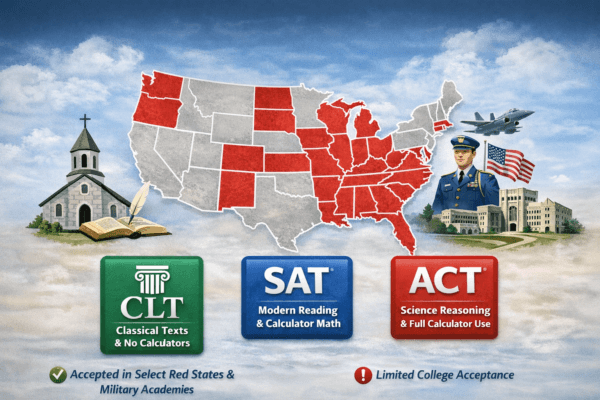
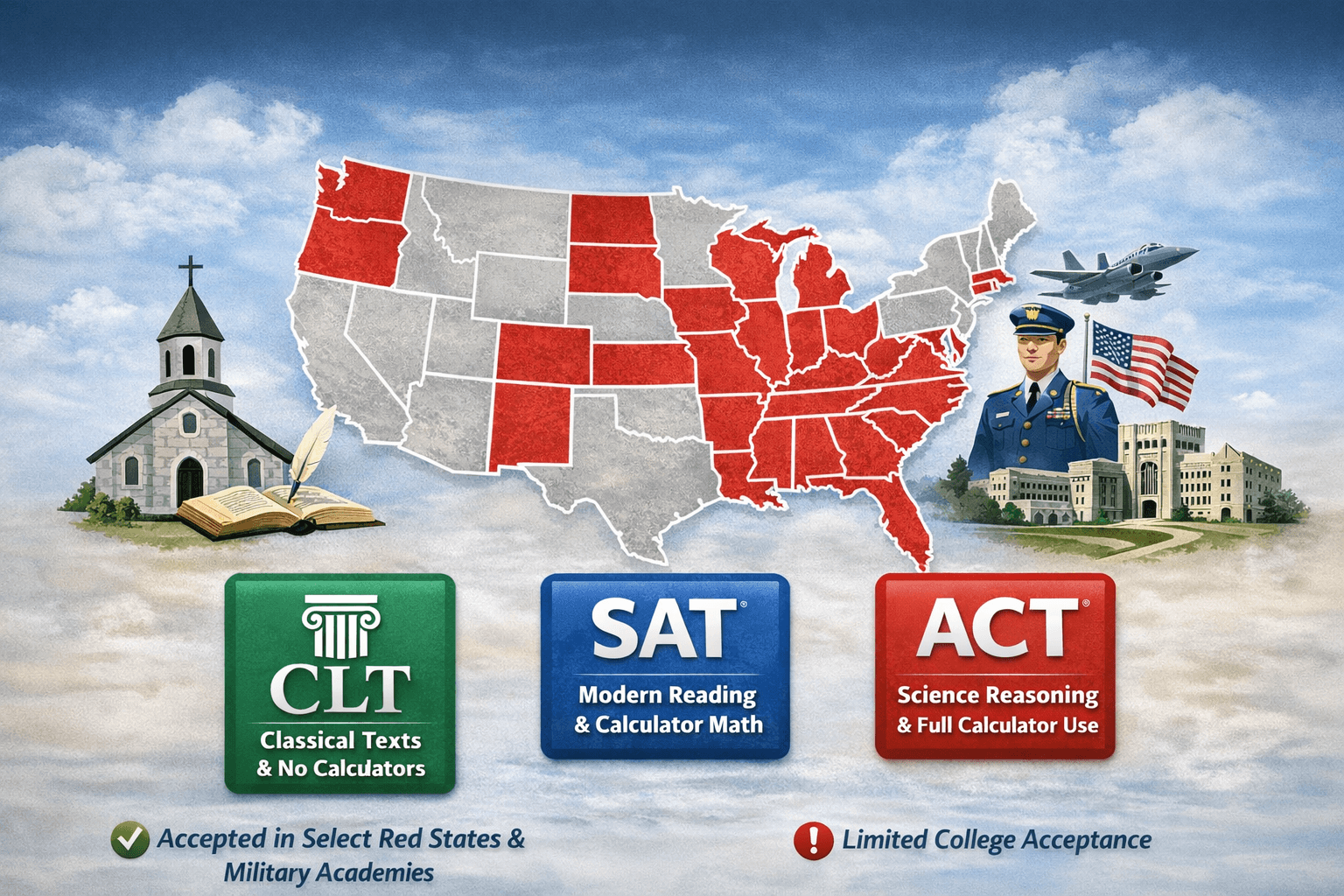
It is important to understand that most schools do NOT accept the CLT. It is mostly accepted my conservative religious schools. It is not accepted by many highly competitive schools. It is not recommended for most students to take only the CLT.
It is now by law accepted by all Florida state schools. So if you are in Florida and have trouble with the SAT, it is a good alternative. It is accepted by St. Johns College Annapolis and Santa Fe with its great books program. Starting with the 2027 admissions cycle, all US military service academies will accept the CLT.
As for scoring, the CLT uses a range from 0 to 120, while the SAT uses 400 to 1600.
Many students appreciate that the CLT uses shorter reading passages and draws from authors like C.S. Lewis, Jane Austen, and Aristotle, making it more engaging and thought-provoking. However, since not all universities accept CLT scores, it is recommended that you also take the SAT and/or ACT.
• Differences with the SAT:
The CLT includes passages from classic literature and philosophy, using more formal or older language (from authors like Plato, Jane Austen, or G.K. Chesterton).
• Verbal Sections:
For students used to modern texts, this can feel more challenging. But for those who enjoy literature, history, or moral reasoning, it can actually be easier and more interesting. Many students find the passages more interesting and educational than the more artificial seeming passages on the SAT and ACT.
• Math Section:
The CLT’s math questions focus on logic and reasoning rather than memorizing formulas. Many students find CLT math more conceptual but less time-consuming than SAT math. The Math CLT does not allow calculators. This is very different from the current version of the SAT, inc ich many problems can be solved with the Desmos graphing calculator. It does not include as many statistics problems as the current versions of the SAT and ACT.
In summary:
The CLT test isn’t harder or easier than the SAT — it just measures different skills.
If you’re strong in reading comprehension, logic, and classical writing, you might find the CLT test more natural. If you prefer data-driven, analytical questions, you may feel more confident with the SAT.

4. What’s on the CLT Exam ?
The Classic Learning Test includes three main sections:
1. Verbal Reasoning: Reading comprehension based on classic literature and philosophy.
2. Grammar/Writing: Questions about sentence structure, word usage, and logical writing.
3. Quantitative Reasoning (Math): Focused on problem-solving, algebra, and logic rather than memorized formulas.
The total testing time is around 120 minutes, with no essay section required.
More info : CLT exam dates 2026
5. How to Prepare: CLT Practice Tests and Study Tips
There is an official practice test and third party practice tests available online. It is recommended you purchase the official guide :
and perhaps other CLT books you can find on Amazon.
6. Benefits of taking the CLT Exam :
Here are some key advantages of the CLT testing
for students.
1- Shorter and More convenient: the test is only two hours long and can often be taken online from home.
2- Immediate results: students typically receive scores within 1-2 Business days.
3- Classical content: Encourages engagement with timeless texts and ideas , not just test tricks.
4- College scholarships: Many partner schools offer scholarships based on CLT performance.
5- Values-Based Assessment: Appeals to students who prefer a moral and intellectual approach to learning.
7. Who should take the CLT Exam :
The classic Learning Test is an excellent choice for:
Students who attend classical or private schools.
Homeschool students who prefer moral and philosophical learning.
There are private and religious schools that take a classical or great books approach, as well as colleges such as St. Johns, which the CLT is particularly compatible with.
Learners who feel limited by the SAT’s Modern style and want a test that values critical thinking and character
8- How Long Is the CLT Test?
Students preparing for college admissions often ask, how long is the CLT Exam , grammar, writing, and mathematics skills in a structured format.
The CLT test typically lasts about two hours, not including short breaks or check-in time. During the exam, students complete multiple sections that measure critical thinking, comprehension, and problem-solving skills rather than speed alone.
9- CLT Scores Explained: What Is a Good, Average, and Passing CLT Score?
Understanding CLT scores is essential for students preparing for the Classic Learning Test and applying to colleges. Many students ask questions like what is a passing CLT score or what is a good CLT score, especially since the CLT is becoming a popular alternative to traditional standardized tests.
What Is a Passing CLT Score?
A common question is: what is a passing CLT score?
Unlike some exams, the CLT does not have a strict “pass or fail” system. Instead, your score is evaluated based on the requirements of the colleges you are applying to.
However, in general:
- A score around 60–70 may be considered a basic passing level
- More competitive colleges typically expect higher scores
What Is a Good CLT Score?
Many students also ask: what is a good CLT score?
A good CLT score usually depends on your target colleges, but generally:
- 80+ is considered a strong score
- 85–95 is competitive for top schools
Achieving a high CLT score can significantly improve your college application.
What Is the Average CLT Score?
If you’re wondering what is a passing CLT score for math , most students fall somewhere in the middle range.
- The average score is typically around 70–75
- Scores above this range are considered above average
Understanding the average CLT score helps you benchmark your performance.
What Is a Bad CLT Score?
Another common concern is: what is a bad CLT score?
Generally:
- Scores below 60 may be considered low
- These scores may limit your options for competitive colleges
However, improvement is always possible with proper preparation.
CLT Test Scores and College Admissions
Your CLT test scores play an important role in admissions, especially at colleges that accept or prefer CLT results. Strong scores can help you stand out, similar to SAT or ACT scores.
Some students also refer to CLT FC scores, which are part of the official scoring breakdown and can provide additional insight into your performance.
What Score Do You Need to Pass the CLT?
Many students ask: what score do you need to pass the CLT?
Again, there is no universal passing score, but aiming for 75+ is generally a safe target for most colleges.
Because the CLT is shorter than some standardized tests, many students find it more manageable and less exhausting. Understanding how long the CLT test is allows students to plan their time effectively and approach the exam with confidence.
CLT Exam Basics
The CLT exam (Classical Learning Test) is a structured standardized test designed to evaluate critical thinking, reading comprehension, grammar, and mathematical reasoning. Understanding the CLT test format is essential for effective preparation and achieving strong results.
- Format: 120 multiple-choice questions divided into three required sections
- Total Time: 2 hours (120 minutes)
- Optional Essay: 30-minute unscored essay
- Scoring: CLT test scores range from 0 to 120
CLT Exam Sections and Sample Questions
To perform well on the CLT test, students must understand the structure of each section and how different types of CLT sample questions are designed. The exam is divided into three main sections, each targeting a specific skill set.
1. Verbal Reasoning (40 minutes, 40 questions)
The Verbal Reasoning section of the CLT exam focuses on reading comprehension, critical thinking, and textual analysis. Passages are drawn from classic literature, philosophy, religion, science, and historical documents, which makes this section unique compared to other standardized tests.
Students are expected to:
- Identify the main idea and overall structure of a passage
- Analyze key details and relationships within the text
- Interpret tone, purpose, and rhetorical techniques
Sample question:
Directions: Carefully read each passage and answer the related questions. The last two questions for each passage involve analogies. Draw on your understanding of the passage and the relationships it presents to determine your answers. All answers should be based solely on the evidence provided in the passage; no external knowledge is needed.
Literature
This passage is from The Great Gatsby by F. Scott Fitzgerald, first published in 1925.
[PASSAGE REMAINS UNCHANGED]
Question: In Paragraph 3, Sentence 2, weather-beaten most closely means:
old and deteriorated by exposure.
recently repaired after a storm.
designed to withstand extreme weather.
expensive and luxurious.
2. Grammar/Writing (35 minutes, 40 questions)
The Grammar/Writing section evaluates a student’s ability to improve written communication. This includes grammar, punctuation, clarity, and style. Reviewing CLT sample questions in this section helps students develop strong editing skills.
Students will need to:
- Correct grammatical and punctuation errors
- Improve sentence clarity and flow
- Choose precise and appropriate word choices
Sample CLT question:
Directions: Carefully read the passages and answer the questions that correspond with each. You will be asked to either correct an error or suggest an improvement to a selected portion of the text. Choose “NO CHANGE” if the text does not require an improvement or correction.
[TEXT REMAINS UNCHANGED]
Question: Which of the following choices represents the clearest and most concise way to convey all the information in the sentence?
He took it out in boxing.
NO CHANGE
He released his frustration by boxing.
Boxing became his outlet for it.
He channeled his emotions into boxing.
3. Quantitative Reasoning (45 minutes, 40 questions)
The Quantitative Reasoning section tests mathematical understanding and logical thinking rather than simple calculation. The CLT math section emphasizes reasoning, problem-solving, and conceptual knowledge.
Topics include:
- Algebra and equations
- Geometry and coordinate systems
- Logical reasoning and word problems
Unlike other tests, the CLT does not allow calculators, which makes mental math and reasoning skills especially important.
Question:
Which function has x-intercepts at 4 and –6?
f(x) = (x − 6)(x – 4)
f(x) = (x + 6)(x + 4)
f(x) = (x − 6)(x + 4)
f(x) = (x + 6)(x – 4)
4. Optional Essay (30 minutes)
The CLT optional essay allows students to demonstrate their ability to construct logical arguments and express ideas clearly. Although it is not scored, it can still be useful for practice and skill development.
Prompt:
Prompt 3: Are there any situations in which censorship of works is appropriate? If so, explain in what context and why. If not, explain why not. Use examples to support your claims.
Essential Steps for CLT Test Prep
Preparing effectively for the CLT exam requires more than just reviewing CLT sample questions. A strong CLT test prep strategy should include the following steps:
- Take a full-length CLT practice test to improve time management and endurance
- Focus on classical texts to become familiar with the style of passages
- Develop strong logical reasoning skills for the math section
- Stay updated on official CLT test dates
- Understand how CLT test scores align with your target colleges
By consistently practicing and understanding the structure of the CLT test, students can improve performance and achieve competitive scores.
Answer Key
Verbal Reasoning: The correct answer is A. Weather-beaten conveys the idea of being worn down and aged by time and elements.
Grammar/Writing: The correct answer is B. This option provides the most clarity by explicitly stating the emotion, frustration, and how it was expressed through boxing. It eliminates any ambiguity, making the sentence clear and precise.
Quantitative Reasoning: The correct answer is D. When a function intercepts the x-axis, f(x) equals zero. For f(x) to equal zero, the factors of the equation need to equal zero. If x + 6 = 0, then x = –6. If x – 4 = 0, then x = 4.
Frequently Asked Questions About the CLT
Is the CLT easier than the SAT?
The CLT isn’t necessarily easier or harder than the SAT. The two tests emphasize different skills and use different formats. Students who are comfortable with classical texts, verbal reasoning, and conceptual mathematics may prefer the CLT, while students who are more familiar with the SAT format may prefer the SAT. The best choice depends on your strengths and the colleges you plan to apply to.
What is a passing CLT score?
There is no universal passing score for the CLT. Colleges set their own admissions requirements, and some scholarships or programs may have specific score thresholds. Instead of targeting a single passing score, students should check the requirements of the colleges and scholarships they are considering.
What is a good CLT score?
A good CLT score depends on the college or scholarship you are targeting. Because there is no universal passing score, compare your score with the requirements or typical expectations of your target schools.
How is the CLT scored?
The CLT reports three section scores—Verbal Reasoning, Grammar/Writing, and Quantitative Reasoning—each on a 1–40 scale. The overall CLT score ranges from 1–120.
How long is the CLT?
The CLT consists of three sections with 40 questions each. Check the current official CLT test information for the latest timing and administration details before test day.