
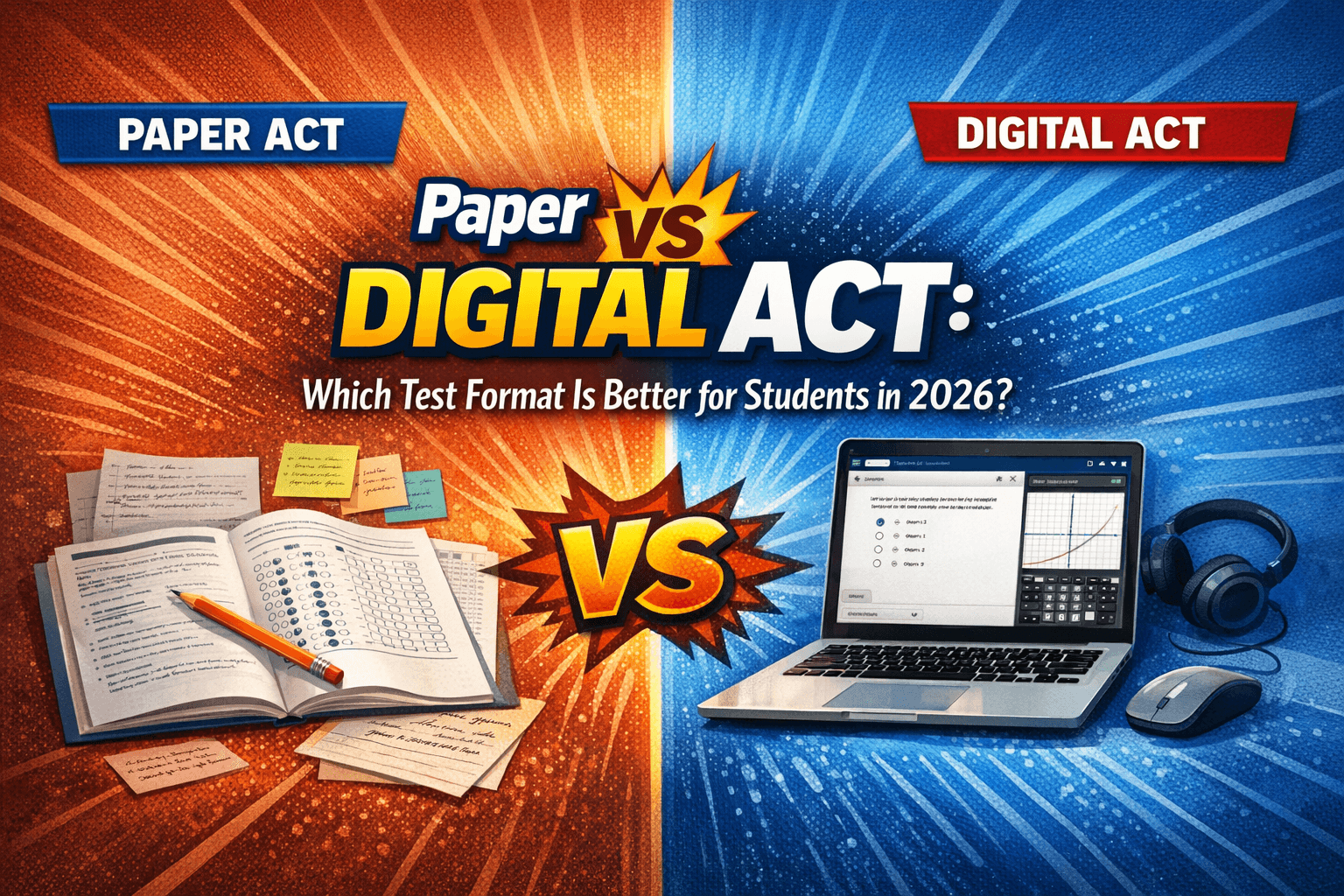
The ACT has undergone one of the most significant transitions in its history with the introduction of the Digital ACT. For decades, students had only one testing option: the traditional paper-and-pencil exam. Today, both formats exist side by side, but this shift has created confusion among students and parents about which version is the better choice.
Based on current testing feedback, educator recommendations, and early performance observations, the Paper ACT remains a strong choice for students who prefer writing directly on test materials, annotating passages, and solving math problems by hand. The Digital ACT, however, offers modern tools and a streamlined interface that may work particularly well for students who are comfortable with computer-based testing.
This article explains the differences between the paper and digital ACT, what each format offers, and which option may be better for different types of students in 2026.
Understanding the Digital ACT
The Digital ACT is a computer-based version of the exam delivered at approved testing centers. Unlike adaptive exams such as the Digital SAT, the Digital ACT format is not adaptive, meaning students do not receive questions that change in difficulty based on their previous performance.
The system includes several built-in digital tools designed to modernize the experience:
- Text highlighting
- Question bookmarking
- Answer elimination tools
- Zoom and accessibility options
- Line reader tools
- Text-to-speech features
- Built-in Desmos graphing calculator for math
In theory, these tools aim to make navigation easier and reduce manual effort. However, in practice, many students still face a learning curve when adjusting to the digital interface, especially under strict time constraints.
The ACT confirms that both online and paper testing formats continue to be available, allowing students to choose the format that works best for them.
Understanding the Paper ACT
The Paper ACT is the traditional format that has been used for decades. Students receive a printed test booklet and a separate answer sheet, completing all work using a pencil.
Despite lacking digital enhancements, the paper format remains widely preferred because it offers full physical control over the test experience.
Students can:
- Write notes directly on passages
- Underline and annotate key information
- Circle and label diagrams
- Work through math problems step by step on paper
- Quickly flip between questions and passages
This level of interaction supports natural test-taking strategies that many students develop throughout their academic journey.
Students preparing for ACT Math can also review an ACT Math Formula Sheet to strengthen their understanding of important formulas before test day.
Paper vs Digital ACT: Key Differences
The main difference between the two formats is not the academic content being tested, but the way students interact with the exam.
| Feature | Paper ACT | Digital ACT |
|---|---|---|
| Test format | Printed test booklet | Computer-based |
| Math work | Easy to organize directly on paper | Students use scratch paper while answering on screen |
| Reading annotation | Physical annotation | Digital highlighting and tools |
| Calculator | Approved calculator | Built-in Desmos plus approved calculator options |
| Navigation | Physical page navigation | Digital navigation tools |
| Screen time | None | Yes |
| Best for | Students who prefer handwriting and physical annotation | Students comfortable with computer-based testing |
Students should consider their own testing habits rather than assuming that one format is universally better.
Are Both Versions the Same Test?
Yes. Both ACT paper and computer formats assess the same core academic skills:
- English
- Math
- Reading
- Science (optional)
- Writing (optional)
The enhanced ACT has changed the structure of the exam, including making Science optional for students taking the standard ACT. ACT also continues to offer both paper and online testing.
ACT research has found that paper and online testing produce comparable 1–36 scale scores. A 2026 ACT research report examining the enhanced ACT also found very small differences between paper and online groups, with equating used to make reported scores comparable.
This means students should not choose a format simply because they believe one version automatically receives a harder or easier score.
Instead, the better choice depends on which testing environment allows the individual student to perform more comfortably and consistently.
Why the Paper ACT Is Still the Recommended Option for Some Students
Despite the introduction of digital testing, many students and test-preparation professionals continue to recommend the paper format for students who are more comfortable with handwritten work and physical annotation.
The reason is simple: it provides greater physical control, familiarity, and stability under exam conditions.
1. Better Control in Math Problem-Solving
Math performance is highly dependent on clarity of thought and structured work. The paper format allows students to:
- Organize calculations visually
- Show full step-by-step reasoning
- Draw diagrams freely
- Work directly beside the question
This can reduce the amount of time students spend switching between the question and their scratch paper.
In contrast, the Digital ACT requires students to read and answer questions on a screen while using scratch paper for calculations. For students who naturally organize their work on paper, this may feel less intuitive.
Many high-scoring students rely on efficient written organization, which is naturally easier on paper.
Students who want additional preparation can work through ACT Math practice to improve their speed, accuracy, and problem-solving skills before test day.
2. Stronger Reading Annotation and Focus
Reading comprehension is another area where paper testing can provide a practical advantage for some students.
On paper, students can instantly:
- Underline evidence
- Mark transitions
- Circle keywords
- Track paragraph structure visually
While digital highlighting tools exist, they may feel slower or less intuitive for students who are used to physical annotation.
Physical annotation can be especially useful for students who already have established paper-based reading strategies.
3. Reduced Technical and Environmental Stress
One often overlooked advantage of the Paper ACT is psychological comfort.
Students taking digital exams must adjust to:
- Screen glare or fatigue
- Device responsiveness
- Software navigation
- Interface distractions
ACT’s online testing system requires students to prepare their devices before test day, including checking device compatibility and completing the required setup.
The paper format removes most device-related concerns, allowing students to focus solely on content and timing.
For many test-takers, this simplicity can contribute to greater confidence and performance.
What About the Digital ACT Advantages?
The Digital ACT does offer certain improvements, and these advantages may make it the better choice for some students.
Built-In Tools and Navigation Features
The digital platform includes:
- Question bookmarking
- Answer elimination tools
- Zoom and accessibility features
- Faster navigation between questions
- Highlighting tools
These features can improve organization, especially for students already comfortable with computer-based testing.
Desmos Graphing Calculator
One of the most notable advantages is the built-in Desmos calculator.
Desmos can be useful for:
- Function graphing
- Equation analysis
- Visual problem solving
For students who already know how to use Desmos effectively, this can provide an efficiency boost in the Math section.
However, this advantage does not automatically make the Digital ACT the better choice. Students should practice using the calculator before test day rather than relying on it for the first time during the actual ACT.
Students who want to prepare for challenging ACT Math questions can also use the ACT Math prep book to practice more advanced problems.
Shorter Testing Experience
The enhanced ACT introduced changes to the test structure, including fewer questions and a shorter testing experience compared with the previous ACT format.
For some students, a shorter test can help reduce fatigue. However, fatigue reduction alone is not enough to determine whether the paper or digital format is better for an individual student.
Why Most Experts Still Recommend the Paper ACT
Across test-preparation organizations and tutoring professionals, a common recommendation remains:
Students should consider sticking with the Paper ACT whenever possible if they perform better with physical test materials.
The reason is not that the Digital ACT is “bad.” Instead, the two formats create different testing experiences, and students should choose the environment that allows them to work most efficiently.
Several test-preparation sources have highlighted the advantages of paper testing for students who prefer physical annotation and handwritten math work, while also recognizing that digital testing may be a good fit for students who are comfortable with computers.
The Most Important Factor: Format Consistency in Practice
Regardless of format, the strongest predictor of ACT success is not simply the test type—it is preparation consistency.
Students perform best when they:
- Practice in the same format they plan to use
- Simulate real test conditions
- Build timing strategies specific to that format
- Take full-length practice tests
- Review mistakes consistently
If a student chooses the Paper ACT, they should:
- Use printed practice tests
- Develop annotation habits
- Practice manual time management
- Practice solving math problems on paper
If a student chooses the Digital ACT, they should:
- Train on digital interfaces
- Learn Desmos efficiently
- Practice reading on screens for extended periods
- Practice navigating digital questions under timed conditions
Students can also strengthen specific math skills by practicing topics such as ACT exponent problems and other common ACT Math question types.
Should i take the act on paper or computer ؟
The Paper ACT may be the better choice for students who:
- Prefer writing directly on test materials
- Rely on visual annotation strategies
- Solve math problems step-by-step on paper
- Experience screen fatigue
- Want a familiar and stable testing environment
For these students, the paper format may provide a practical performance advantage.
Who Might Consider the Digital ACT?
The Digital ACT may be suitable for students who:
- Are highly comfortable with computer-based exams
- Regularly use digital tools for studying
- Prefer streamlined navigation systems
- Have strong experience with Desmos
- Do not struggle with screen-based reading
Even in these cases, careful practice is essential before choosing the digital format.
Does the Digital ACT Have a Harder Grading System?
There is no official evidence that the Digital ACT is simply graded more harshly than the Paper ACT.
ACT research specifically addresses comparability between paper and online testing. ACT’s research indicates that paper and online tests are linked to the same score scale and use equating methods to account for differences in test difficulty.
A newer ACT research report on the enhanced ACT similarly found very small differences between paper and online testing groups and used equating to ensure reported scores remain comparable.
Therefore, students should not choose a format based on the belief that the Digital ACT automatically has harder grading.
Instead, students should focus on the format that allows them to answer questions accurately and efficiently.
Are Paper ACT and Digital ACT Scores Treated the Same?
Yes. ACT has stated that paper and computer-based scores are comparable and intended to have the same meaning.
The important consideration is therefore not whether colleges value one format more than the other, but whether the student performs better in one testing environment.
Students should also check the requirements of their target colleges when deciding whether to take optional Science or Writing sections.
How to Prepare for the Paper ACT
Students choosing the Paper ACT should make their practice as similar as possible to the real testing environment.
A strong preparation routine should include:
- Printed practice tests
- Handwritten math calculations
- Passage annotation
- Timed sections
- Full-length practice exams
- Regular review of mistakes
For Math preparation, students can review the ACT Math Formula Sheet and then reinforce those concepts with ACT Math practice and targeted practice questions.
How to Prepare for the Digital ACT
Students choosing the Digital ACT should practice using a computer well before test day.
Preparation should include:
- Taking digital practice tests
- Practicing reading on a screen
- Learning the available navigation tools
- Practicing with Desmos
- Using scratch paper efficiently
- Practicing under timed conditions
The goal is to make the digital interface feel familiar before the actual exam.
When Is the Next ACT Test Date?
Choosing between the Paper ACT and Digital ACT is only one part of ACT preparation. Students should also plan around upcoming test dates, registration deadlines, and their study schedule.
For the 2026–2027 national ACT schedule, upcoming test dates include October 17, 2026, December 12, 2026, February 27, 2027, April 10, 2027, June 12, 2027, and July 10, 2027.
Check the latest ACT test dates and registration deadlines to choose an appropriate test date and allow enough time for preparation.
Planning your test date early can help you determine how many weeks you have available for ACT Math practice, full-length exams, and review.
Final Thoughts: Paper vs Digital ACT
While both formats measure the same academic skills, the testing experience can be very different.
The Paper ACT remains a strong option for students who value physical annotation, handwritten math work, and a familiar testing environment.
The Digital ACT can be a strong alternative for students who are comfortable working on a computer and want access to digital navigation tools and the built-in Desmos calculator.
The best choice is ultimately the format that allows each student to work most efficiently and confidently.
For students aiming for the highest possible score, consistency, familiarity, and control remain important factors. The Paper ACT may continue to be the preferred choice for students who perform better with physical test materials, while the Digital ACT may be ideal for students who are already comfortable with computer-based testing.
Before making a final decision, students should practice both formats when possible, compare their timing and accuracy, and choose the format that produces the strongest and most consistent practice-test results.
When Is the Next ACT Test Date?
Find the latest ACT exam schedule, registration deadlines, and score release dates.
When is the next ACT test date?
Sources
- College Confidential — Digital ACT: Is It Truly Unadvised?
- PrepScholar — Should You Take the Digital or Paper ACT?
- LA Tutors 123 — Paper or Digital ACT: Navigating the Digital ACT in a Time of Transition
- U.S. News — How to Choose Between the Digital and Paper ACT
- ACT Research — Comparability of ACT Scale Scores From Paper and Online Testing
- ACT — Online Testing and Device Setup
- ACT — Enhanced ACT FAQs