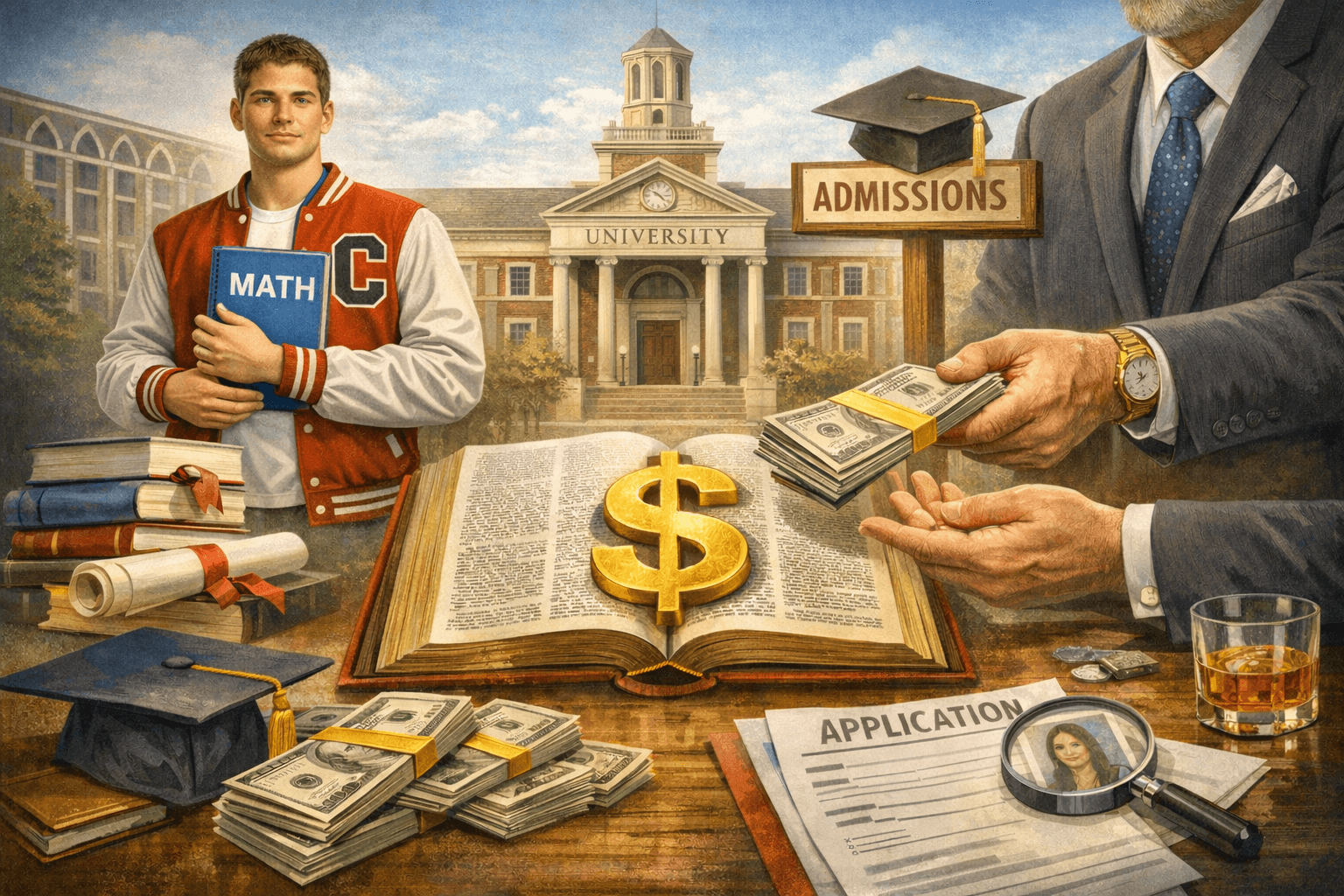
Top colleges accept students with lower academics who have “hooks”. Big hooks include being a recruited athlete, being an from an underrepresented minority group, and being from an underrepresented part of the country counts for something. There are also connections, political connections are big, and being from well connected family. Going to a good prep school also helps some.
One method of buying in is legacies. Alumni contribute to their alma maters and then their children or other relatives are accepted. This is a relatively subtle method.
Students who get in with money or other hooks will generally be below average students. There is a limit to what you can buy. In some ways the schools are also clubs of people with money and connections.
This also goes on with prep schools and professional schools. With prep schools, the qualification can be more background than academics and newly wealthy people buy their kids in.
There is probably much buying into high ranking law and MBA schools. About half of medical students have a parent who was a doctor. It is likely many are “legacies”, in that the doctor contributes to his medical school.
Competitive colleges and universities, private schools, and professional schools are financed to a large degree by their endowment. This is to some extent a euphemism for selling admissions.
Very competitive smaller colleges, as opposed to universities, tend to have a large percentage of the students with “hooks”, a high percentage of them money, mostly “legacies”. These school are considered “preppy” and have a high percentage of private school graduates. They are sort of clubs for connections. They usually do not offer much financial aid. When I was in school, some had names of students in the catalog, and mostly British names, sometimes classy sounding.
Sometimes student wind up being bought into schools which are difficult for them, and it is about the parents status issues. Getting admitted will not make you a better student, and students who are bought in will often not get top grades and may take relatively easy majors.
Real-World Examples of Elite College Admissions Scandals
The firm Ivy Coach
https://www.ivycoach.com/
sued parents in (now de facto capitalist) Vietnam who agreed to $1.5 million package to buy daughter into a top college:
https://nypost.com/2018/02/10/mom-agreed-to-give-consultant-1-5m-to-help-kids-college-admissions-suit/
They got her into Solesbury School and Dartmouth. They paid the first half, but not the second half of the payment. Probably part of the purpose of their suit was to publicize their services. Probably parents overseas would not know how to buy students in, and would use a service like this.
The Varsity Blues Scandal in College Admissions
The Varsity Blues scandal:
https://en.wikipedia.org/wiki/Varsity_Blues_scandal
Involved a college advising firm which got students in without contributing to the schools. Several college coaches were also convicted and lost their jobs. The people running it got prison sentences and the parents shorter sentences. The firm would pay off a coach in obscure sport to say the student was a recruited athlete. The admissions standards for recruited athletes are much lower. The firm also had people take SAT and SAT II exams for the students. Of course, it is perfectly legal to buy a student in with contributions.
Cost, Access, and Global Differences in College Admissions
Private US colleges are very expensive, just in terms of tuition, so many students do not attend just because of cost. Wealthy people also pay for tutoring etc. to help their children do well academically.
All this applies to schools in the US. In many countries, admissions is more based on “qualifications” and it is not possible to buy your way in. In Britain, there are not issues of needing tuition money or buying in, but admissions is based on knowledge in specialized areas, which gives advantages to students from better high schools. In most countries, universities are government run and subsidized by tax money. You can’t buy your way in with contributions, but there may be some straight corruption. Also, there are generally not highly selective universities outside of the US and England.
Additional Resources on Elite College Admissions
https://www.applywithsanity.com/blog-1/2019/3/21/how-do-wealthy-kids-get-into-elite-colleges
This book gives more information:
https://www.amazon.com/Price-Admission-Americas-Colleges-Outside/dp/1400097975
Impact of Wealth on College Admissions and Education
Beyond admissions, wealth can continue to influence a student’s entire educational journey. Students from affluent families often have access to private tutoring, test preparation programs, and academic coaching that significantly improve their chances of maintaining admission standards once accepted.
This creates a cycle where financial resources not only help students get into elite colleges but also support them throughout their academic life.
College Admissions Hooks and Advantages
One of the most important factors in elite college admissions is the presence of “hooks”. These college admissions hooks include athletic recruitment, legacy admissions, and geographic diversity.
The use of hooks in elite colleges admissions creates a system where academic performance is not the only deciding factor.
Legacy Admissions and Alumni Influence
Legacy admissions play a major role in the college admission process, where children of alumni receive preference due to family contributions and institutional loyalty.
This system is closely tied to wealthy students admissions patterns in private universities.
Prep Schools and College Admissions Advantage
Attendance at prep schools provides a strong prep schools advantage, giving students access to better counseling, academic preparation, and elite college networks.
This significantly impacts outcomes in private school admissions and elite universities.
Networking, Connections, and College Consulting
Networking and institutional connections are also key factors in elite colleges admissions. Families with strong political or professional ties often benefit from recommendation influence.
In addition, the growth of college consulting services has increased competition among applicants with financial resources.
Financial Aid vs Full-Pay Students in Elite Colleges
In many private institutions, full-pay students contribute significantly to the college endowment influence, making them financially attractive to universities.
This affects how admissions decisions are balanced between need-based and full-pay applicants.
Ethical Issues in College Admissions System
The influence of wealth raises ongoing concerns about fairness in the Elite College Admissions process and broader inequality in education systems.
Scandals like Varsity Blues scandal highlight how far some families go to gain advantage in elite admissions.
While academic merit remains important, the Elite College Admissions system is shaped by a complex mix of wealth, connections, legacy, and institutional priorities. Understanding these elite education systems factors helps explain why admissions outcomes often extend beyond academic performance alone.